
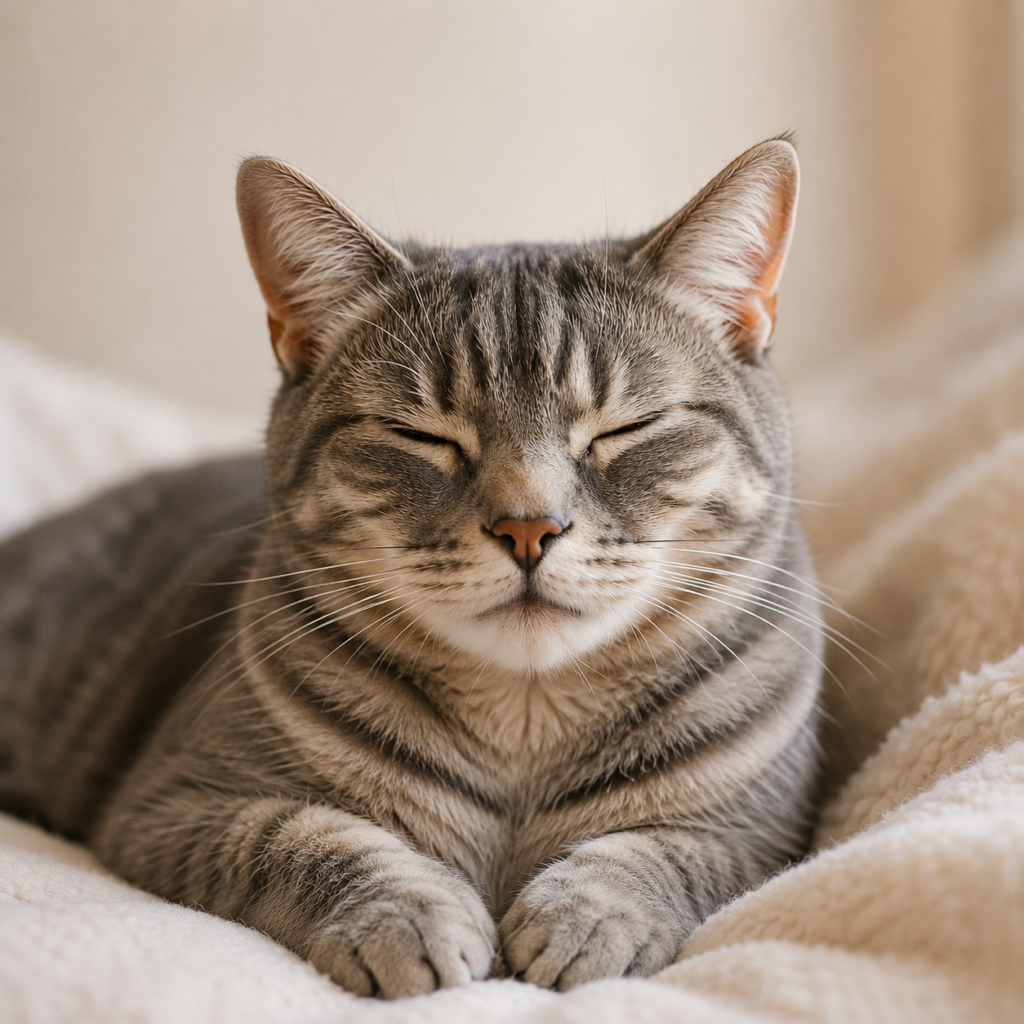
When a relaxed cat looks toward you, gently narrows its eyes, closes them for a brief moment, and slowly opens them again, you may be seeing what is commonly called a cat slow blink.
This subtle expression is often associated with calm, positive interaction. It may appear when a cat feels comfortable enough to soften its gaze in your presence. However, no single facial movement should be interpreted on its own. The cat’s posture, ears, tail, environment, and overall behavior also matter.
Watch the Short Video
A quick explanation of what your cat’s slow blink may communicate.
What Is a Cat Slow Blink?
A slow blink is different from the quick, automatic blinking that protects and moistens the eye. It usually involves a gradual narrowing of the eyelids, followed by a brief partial or complete eye closure.
A relaxed slow-blink interaction may include:
- softly narrowed eyes;
- one or more slow eye closures;
- a relaxed face and muzzle;
- ears held in a natural position;
- a loose, comfortable body posture;
- no obvious attempt to escape or defend itself.
The cat may be resting, sitting beside a familiar person, or calmly observing someone from a comfortable distance.
Why Does Your Cat Slow Blink at You?
A cat that feels safe and relaxed may not need to maintain a wide, alert stare. Slowly narrowing or closing the eyes can occur during a calm, non-threatening interaction.
Depending on the situation, a slow blink may be associated with:
- relaxation;
- comfort;
- friendly social intent;
- reduced tension;
- a willingness to remain near you;
- a positive response to gentle interaction.
Many people affectionately call the slow blink a “cat kiss.” This is a memorable description, but it should not be treated as a literal translation. Cats communicate through combinations of facial expressions, posture, movement, scent, vocalization, and previous experience.
Does a Slow Blink Really Mean Trust?
Research suggests that slow eye-narrowing movements may be involved in positive communication between cats and people.
In controlled interactions, cats were more likely to perform slow-blink movements after a person had slowly narrowed their own eyes. Cats were also more likely to approach an unfamiliar person after a slow-blink interaction than after the person displayed a neutral facial expression.
These findings support the idea that slow blinking can contribute to a calm and positive interaction. They do not prove that every slow blink has exactly the same meaning or that the movement alone confirms affection.
A slow blink from a relaxed cat is often a positive sign of comfort and friendly communication.
How to Slow Blink Back at Your Cat
You can gently return the expression without forcing your cat to interact.
- Sit or stand at a comfortable distance.
- Keep your shoulders, face, and body relaxed.
- Look toward your cat without maintaining an intense stare.
- Slowly narrow your eyes.
- Close them gently for a brief moment.
- Open them slowly and consider looking slightly away.
Your cat may slow blink in return, remain relaxed, turn its head away, approach you, or simply continue resting. A cat does not need to respond for the interaction to be successful.
Do not repeatedly stare or move closer if your cat appears uncomfortable. The purpose is to offer a calm signal, not to demand attention.
Why Direct Staring Can Feel Different
People commonly use direct eye contact during friendly conversation. Cats may interpret prolonged, intense staring differently, especially when they do not know the person well or cannot move away easily.
A softer gaze, slow blinking, relaxed posture, and occasional looking away may appear less confrontational than fixed eye contact.
Give the cat control over the distance. Avoid leaning over, cornering, holding, or following the cat simply to obtain a slow-blink response.
Read the Whole Body, Not Only the Eyes
The eyes provide only one part of the message. A meaningful interpretation requires attention to the entire body.
Signs that may accompany a relaxed slow blink
- ears resting naturally or facing gently forward;
- soft facial muscles;
- normal-sized pupils for the lighting conditions;
- whiskers held in a neutral position;
- a loose body rather than a tense or crouched posture;
- a relaxed or gently curled tail;
- normal breathing;
- willingness to remain in the same area.
Signs that may indicate discomfort or stress
- ears flattened or rotated tightly backward;
- a tense, frozen, or very low body posture;
- rapid tail flicking or forceful tail movement;
- very wide pupils that do not match the lighting;
- growling, hissing, or swatting;
- rapid blinking rather than a soft, deliberate blink;
- repeated attempts to hide or move away;
- refusal of contact that the cat normally accepts.
If the rest of the body looks tense, do not assume that partially closed eyes mean affection. Give the cat space and allow it to decide whether to continue the interaction.
Do Cats Slow Blink Only at People They Know?
Cats may slow blink during interactions with familiar people, but the behavior is not necessarily limited to their primary caregiver.
A cat may respond positively to an unfamiliar person who behaves calmly, remains at a respectful distance, avoids forceful handling, and uses a soft gaze. Personality, socialization, previous experiences, and the environment can all influence the response.
Some cats are naturally more socially expressive, while others communicate in quieter ways. A cat that does not slow blink frequently is not necessarily unfriendly or unhappy.
What If Your Cat Does Not Slow Blink Back?
There is no need to repeat the movement until the cat responds. Your cat may be distracted, sleepy, watching something else, or simply uninterested at that moment.
Instead, observe whether the cat:
- remains comfortably nearby;
- rests or grooms in your presence;
- approaches you voluntarily;
- shows a relaxed posture;
- initiates contact at another time.
Trust is shown through many behaviors. Slow blinking is only one possible part of the relationship.
Slow Blinking or an Eye Problem?
A relaxed slow blink is usually brief, soft, and connected to the social situation. Persistent squinting or holding an eye closed can look superficially similar but may signal discomfort or disease.
Possible warning signs include:
- keeping one eye partly or completely closed;
- frequent or continuous squinting;
- redness;
- excessive tearing;
- yellow, green, white, or cloudy discharge;
- cloudiness or a visible change in the eye;
- swelling around the eye;
- rubbing the face or eye with a paw;
- sensitivity to light;
- unequal pupil size;
- a visible third eyelid;
- signs of pain or reduced activity.
Eye discomfort may be associated with conjunctivitis, injury, a foreign object, corneal damage, inflammation, infection, or another condition. It is not possible to identify the exact cause from blinking alone.
When Should You Contact a Veterinarian?
Contact your veterinarian if your cat repeatedly squints, keeps one eye closed, develops discharge, shows redness, rubs the eye, or appears uncomfortable.
Seek prompt veterinary attention if:
- the eye was injured;
- there is sudden cloudiness or color change;
- the pupils are noticeably unequal;
- the cat appears unable to see normally;
- there is significant swelling or pain;
- the eye looks damaged or displaced;
- the symptoms develop suddenly or worsen quickly.
Eye conditions can progress rapidly, and some may threaten vision. Avoid using human eye drops, leftover medication, or home remedies unless a veterinarian has specifically instructed you to do so.
How to Encourage Calm Interaction With Your Cat
Slow blinking works best as part of a respectful relationship rather than as an isolated trick.
- Let your cat choose when to approach.
- Provide safe hiding and resting places.
- Avoid sudden movements and loud sounds.
- Do not force petting or handling.
- Learn which types of touch your cat prefers.
- Use play and enrichment appropriate for your cat.
- Keep routines reasonably predictable.
- Watch for early signs that your cat wants space.
Respecting a cat’s choices can help create a more secure environment and strengthen communication over time.
Common Myths About the Cat Slow Blink
“A slow blink always means I love you.”
It is better understood as a possible sign of relaxed and positive communication. Human words do not translate perfectly into individual feline expressions.
“A cat that does not slow blink does not trust me.”
Cats vary considerably in personality and communication style. Trust may also be shown by resting nearby, approaching voluntarily, grooming, playing, or maintaining a relaxed posture around you.
“Any half-closed eye is a slow blink.”
No. Persistent squinting, frequent blinking, discharge, redness, or keeping one eye closed may indicate discomfort and should not be mistaken for friendly communication.
“I should move closer until my cat responds.”
No. Give your cat control over the distance. A calm interaction should never involve cornering, restraint, or pressure.
Frequently Asked Questions
Why does my cat slow blink and then look away?
Looking away may help keep the interaction calm and non-confrontational. If the cat’s body remains relaxed, it is usually not a reason for concern.
Should I slow blink at a cat I have just met?
You can use a soft gaze and a gentle slow blink from a respectful distance. Avoid leaning over the cat or attempting immediate physical contact. Let the cat decide whether to approach.
Why does my cat slow blink while lying down?
A comfortable resting cat may naturally have soft, partially closed eyes. A deliberate slow blink directed toward you may occur as part of a calm interaction.
Can stress cause blinking?
Yes. Rapid blinking, looking away, narrowed eyes, or tightly closed eyes can occur in uncomfortable situations. The speed of the blinking, posture, environment, and other signals help distinguish stress from a relaxed slow blink.
Why is my cat squinting only one eye?
Persistent one-sided squinting is more suggestive of irritation, injury, or pain than normal social slow blinking. Check for redness, tearing, discharge, swelling, or rubbing, and contact your veterinarian.
Can a cat slow blink without feeling affectionate?
Yes. A slow blink may reflect relaxation or reduced tension without necessarily representing the same emotional experience that people describe as affection.
Final Thoughts
A cat slow blink is often part of a calm and positive interaction. It may occur when your cat feels relaxed, comfortable, and safe enough to soften its gaze around you.
You can try slowly blinking back, but always pay attention to the entire body and allow your cat to control the interaction. Slow blinking should remain soft, brief, and voluntary.
If the eye stays partly closed or you notice redness, discharge, cloudiness, swelling, rubbing, or signs of pain, treat it as a possible health concern rather than normal communication and contact your veterinarian.
Sources and Further Reading
- Scientific Reports — The role of cat eye narrowing movements in cat–human communication.
- International Cat Care — Cat communication, handling, and interaction guidance.
- Cornell Feline Health Center — Feline eye and vision problems.
- VCA Animal Hospitals — Conjunctivitis, squinting, and eye discomfort in cats.
Written by a veterinarian for Pawsvexa.
This article is intended for general educational purposes and does not replace an examination, diagnosis, or treatment plan from your veterinarian.