
PAWSVEXA BEHAVIOR GUIDE
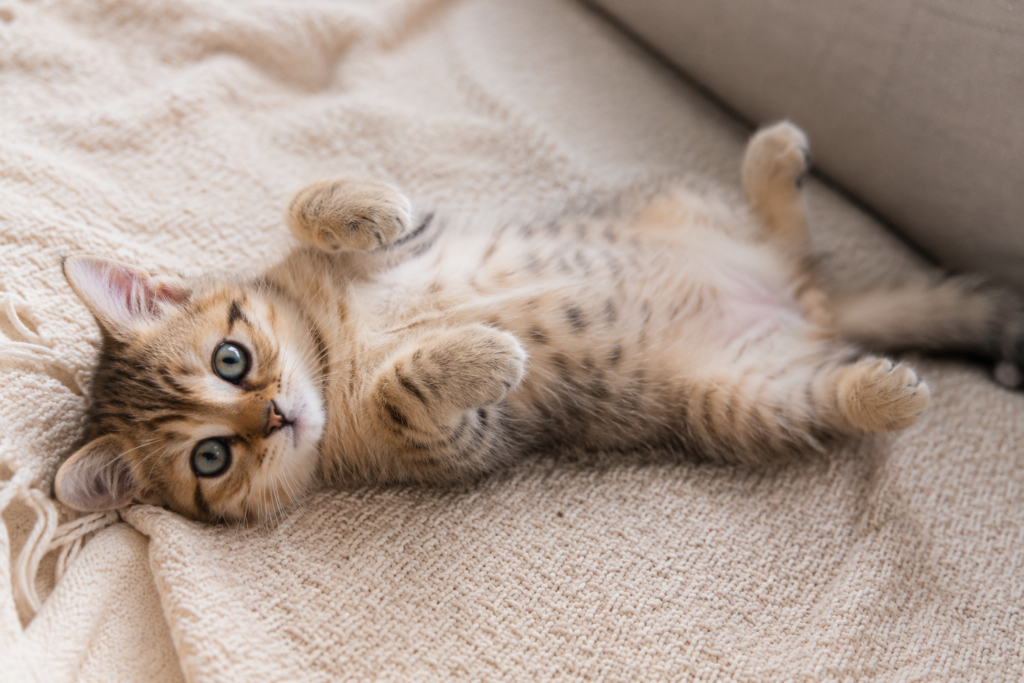
The gesture looks like an invitation. A cat rolls onto its back, stretches out its paws, and exposes the softest, most vulnerable part of its body. But what appears simple is often a more nuanced message about trust, comfort, boundaries, play, or defensive readiness.
Why does your cat show you its belly? In a relaxed setting, the posture may indicate that your cat feels secure enough to lower its guard around you. However, feeling safe and wanting the abdomen touched are two different things.
The most accurate interpretation comes from reading the entire cat: the ears, eyes, whiskers, tail, paws, muscle tension, breathing, and what was happening immediately before the roll.
The key distinction: showing the belly may communicate trust, but permission to touch must be read separately from the cat’s response and complete body language.
What Does It Mean When a Cat Shows Its Belly?
A cat’s abdomen contains delicate organs and lacks the protection offered by the rib cage. Exposing this area places the cat in a physically vulnerable position, which is one reason a loose, relaxed belly-up posture can be associated with a sense of safety.
In a calm home environment, your cat may roll over because it is:
- comfortable and deeply relaxed
- showing social trust
- stretching or changing its resting position
- initiating playful interaction
- seeking attention without necessarily requesting touch
- responding to your voice, movement, or arrival
The posture does not have one universal meaning. A cat resting quietly beside a familiar person is communicating something different from a tense cat that rolls onto its back after being cornered, chased, or overstimulated.
Context matters as much as posture.
Trust Is Not the Same as Consent to Touch
This is the point many owners misunderstand. A cat can trust you completely and still dislike having its belly touched.
Trust describes how safe the cat feels in your presence. Consent describes whether the cat wants a specific interaction at that moment. The two may overlap, but they are not interchangeable.
Some cats expose their abdomen as part of a relaxed greeting and then react immediately when a hand moves toward it. They may grab the hand with their front paws, kick with the hind legs, turn sharply, bite, or leave.
This is not necessarily a sudden betrayal or unexplained aggression. The cat may have been comfortable with your presence but uncomfortable with the location, pressure, duration, or intensity of the touch.
The abdomen is sensitive, and many cats retain a strong protective response around it. Respecting that boundary helps preserve trust rather than weaken it.
How to Read the Whole Cat
No single ear, tail, or eye position should be interpreted in isolation. Body-language signals become more meaningful when several appear together and when they are considered in context.
| Relaxed and comfortable | Becoming overstimulated | Defensive or protective |
|---|---|---|
|
Loose muscles Soft facial expression Neutral ears Relaxed paws Slow blinking Quiet or gently moving tail |
Tail beginning to flick Skin twitching Head turning toward the hand Paws becoming tense Sudden alert expression Body gradually stiffening |
Flattened or sideways ears Dilated pupils Stiff body posture Claws prepared to engage Hind legs positioned to kick Hissing, growling, biting, or striking |
Signs of a relaxed belly-up posture
A relaxed cat usually appears physically loose. The legs may rest naturally rather than being held rigidly against the body. The paws are soft, the claws remain retracted, and the eyes may be partially closed or slowly blinking.
The ears generally remain neutral or gently forward. Breathing is calm, and the tail is still or moving slowly rather than striking the floor.
Even in this relaxed state, the cat may prefer interaction around the cheeks, forehead, chin, or shoulders instead of the abdomen.
Signs that the interaction should stop
A cat’s emotional state can change within seconds. Early signs of discomfort may be subtle:
- the tail begins flicking more sharply
- the skin along the back or sides twitches
- the ears rotate sideways or backward
- the paws curl or become tense
- the cat turns its head quickly toward your hand
- the body becomes noticeably stiffer
- the pupils enlarge
These signals often appear before biting or kicking. Stopping at the first change is safer and teaches the cat that its communication works.
When a Belly-Up Cat Is Being Defensive
A cat lying on its back is not always relaxed. In a threatening situation, the position may allow the cat to use its teeth, front claws, and powerful hind legs simultaneously.
A defensive belly-up posture usually looks very different from a relaxed roll. The body may be rigid, the pupils wide, the ears flattened, and the paws held in readiness. The tail may lash, and the cat may vocalize, stare, hiss, or strike.
Do not reach toward or attempt to restrain a cat displaying these signals. Reduce pressure, move slowly, provide an escape route, and allow the cat to increase distance.
Defensive behavior is often a last resort when avoidance has failed. Punishment can increase fear and make future reactions stronger.
How Should You Respond When Your Cat Shows Its Belly?
The best response is not to assume. Let the cat guide the interaction.
- Pause and observe. Look at the ears, tail, paws, eyes, and overall muscle tension.
- Offer your hand without reaching over the cat. Allow the cat to sniff, approach, or rub against you.
- Begin with a preferred area. Many cats favor the cheeks, chin, forehead, or sides of the face.
- Keep contact brief. After a few gentle strokes, pause and observe what the cat chooses next.
- Continue only if the cat actively seeks more. Leaning in, rubbing, or repositioning toward the hand suggests that interaction is still welcome.
- Stop at the first sign of tension. Do not wait for the cat to bite or kick.
Giving the cat control over the duration and intensity of contact can reduce conflict and support more positive human–cat interactions.
Why Do Some Cats Enjoy Belly Rubs?
Individual preferences vary considerably. A small number of cats appear to enjoy gentle abdominal contact, particularly when they have had positive handling experiences and feel fully secure with the person touching them.
Preference can also change with mood, environment, age, previous experience, and physical comfort. A cat that accepts a brief belly rub today may reject it tomorrow.
Look for genuine participation rather than simple tolerance. A comfortable cat remains loose, does not attempt to move away, and may actively reposition for continued contact. A motionless cat is not automatically a consenting cat; some cats freeze when uncertain or stressed.
Even when your cat normally enjoys belly rubs, keep the pressure light and the interaction brief.
Why Does My Cat Grab and Kick My Hand?
The rapid combination of grabbing with the front paws and kicking with the hind legs is sometimes called “bunny kicking.” It can appear during play, predatory behavior, overstimulation, or defensive handling.
When directed toward a hand during belly contact, it often means the interaction became too intense or crossed the cat’s preferred boundary.
Avoid pulling your hand away violently, as sudden movement may increase chasing or grabbing. Stop the interaction, remain calm, and allow the cat to release and move away.
Hands should not be used as toys. For playful cats, redirect kicking and wrestling toward a suitable long toy or sturdy kicker toy instead.
Could Sudden Belly Sensitivity Mean Pain?
A long-standing dislike of belly touching is usually a normal individual preference. A sudden change is more significant.
Arrange a veterinary examination if a normally tolerant cat begins protecting its abdomen or reacts painfully, particularly when the change appears with:
- reduced appetite
- vomiting or diarrhea
- unusual hiding or withdrawal
- reduced activity
- difficulty jumping or moving
- repeated licking of the abdomen
- a tense, swollen, or enlarged abdomen
- vocalization when touched or lifted
- changes in urination or defecation
Urgent warning: repeated straining to urinate, frequent unsuccessful litter-box visits, crying while attempting to urinate, collapse, marked weakness, breathing difficulty, or a severely distended abdomen requires prompt veterinary attention.
Cats frequently express discomfort through changes in behavior rather than obvious crying. New sensitivity should therefore be assessed alongside appetite, movement, litter-box habits, grooming, social behavior, and general energy level.
Read more in the Pawsvexa guide:
Why Cats Hide Pain: Warning Signs Owners May Miss
.
Respecting Boundaries Builds More Trust
The most valuable response to a belly display is not a belly rub. It is attention.
When owners notice subtle signals and respond before the cat needs to bite, scratch, or escape, interactions become more predictable. Predictability helps cats feel safer.
You can also strengthen your understanding of feline communication by reading:
-
Why Does Your Cat Slow Blink at You?
-
Why Do Cats Knead With Their Paws?
-
Why Does My Cat Sleep Near My Head?
Frequently Asked Questions
Does a cat showing its belly mean it loves you?
Not by itself, but a loose belly-up posture in a calm setting can suggest that the cat feels safe and comfortable around you. Look at the complete body language and the wider relationship rather than one position alone.
Why does my cat show its belly and then bite me?
The cat may have welcomed your presence but not abdominal touch. Biting can follow overstimulation, a protective reflex, play, or a warning that the interaction continued beyond the cat’s limit.
Should I rub my cat’s belly?
Only when the individual cat repeatedly demonstrates that it enjoys this contact. Begin with a preferred area, keep any abdominal touch very gentle and brief, and stop immediately if the body becomes tense.
Why does my kitten keep rolling onto its back?
Kittens may roll during play, relaxation, social interaction, or exploration. Observe whether the kitten is loose and playful or tense and defensive, and use toys rather than hands for wrestling behavior.
Can belly sensitivity be a sign of illness?
Yes. Sudden abdominal guarding or pain can accompany several medical problems. Veterinary evaluation is appropriate when the sensitivity is new, severe, or associated with appetite, digestive, urinary, movement, or behavior changes.
The Pawsvexa Takeaway
A cat showing its belly may be expressing comfort, trust, playfulness, or simple relaxation. In other situations, the same general posture can be part of a defensive response.
The difference lies in the details: loose or tense muscles, neutral or flattened ears, quiet or lashing tail, relaxed or prepared paws.
Most importantly, exposure is not automatic permission. Allowing your cat to choose the location, duration, and intensity of contact is one of the clearest ways to respect its communication and protect the trust it is offering.
Pawsvexa — pet care by a veterinarian.
Written and reviewed by a veterinarian for Pawsvexa.
Medical note: This article is intended for general educational purposes and does not replace an individual veterinary examination, diagnosis, or treatment. Contact a veterinarian if your cat develops sudden pain, abdominal swelling, urinary difficulty, persistent vomiting, weakness, or other unusual symptoms.
Sources and Further Reading
-
Rodan I, et al.
2022 AAFP/ISFM Cat Friendly Veterinary Interaction Guidelines.
-
American Association of Feline Practitioners.
Feline Behavior Guidelines.
-
Haywood C, et al.
Providing Humans With Practical Best-Practice Handling Guidelines During Human–Cat Interactions.
-
International Cat Care.
Handling and Interactions.
-
Cornell Feline Health Center.
Feline Behavior Problems: Aggression.
-
Cornell Feline Health Center.
Feline Lower Urinary Tract Disease.