
Written by a qualified veterinarian.
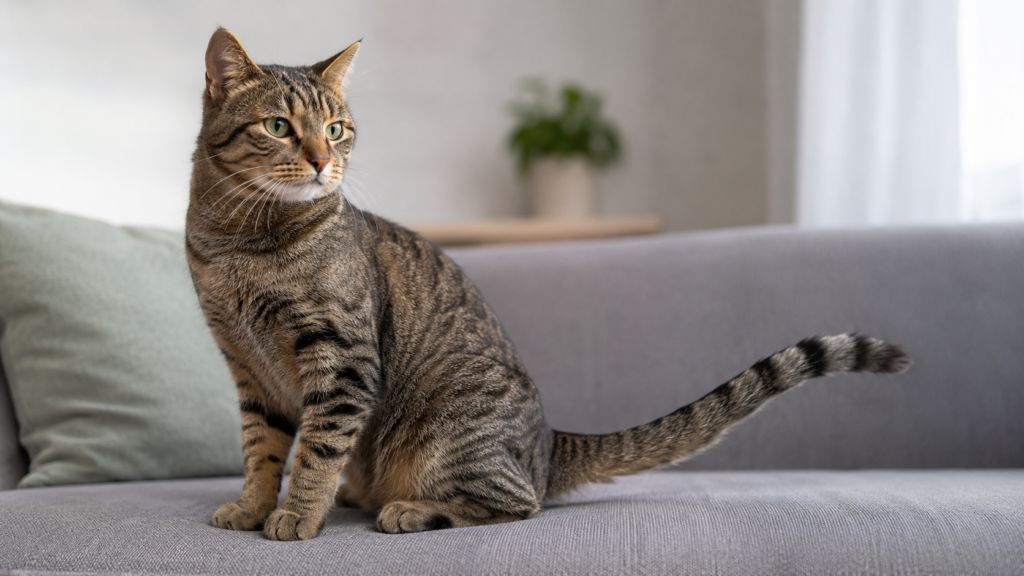
Why is my cat flicking its tail? A moving tail usually reflects a change in attention or emotional arousal, but it does not have one fixed translation. A small twitch while watching a bird is different from hard, repeated lashing during petting.
The speed and force of the movement matter, but so do the ears, eyes, whiskers, muscle tension, posture, distance from a trigger, and what happened immediately beforehand. Tail flicking may accompany focused play, uncertainty, frustration, overstimulation, fear, defensive readiness, or physical discomfort.
This guide explains the most useful patterns, how to respond without escalating the interaction, and when a new or intense change should be assessed by a veterinarian. The goal is not to label every tail movement. It is to read the whole cat and recognize when the message has changed.
Watch: Why Is Your Cat Flicking Its Tail?
Prefer watching first? Watch the short Pawsvexa video, then continue reading the complete veterinary guide below.
Why Is My Cat Flicking Its Tail? The Simple Answer
Tail flicking most often means that something has captured your cat’s attention or changed its level of arousal. That change may be positive, neutral, or uncomfortable. A cat tracking a toy can be highly focused without being afraid, while a cat whose tail begins striking the floor during petting may be asking for the contact to stop.
Movement that is slow, brief, and accompanied by loose muscles and neutral ears is generally less concerning than movement that becomes fast, forceful, repetitive, and paired with a stiff body, dilated pupils, ears rotated backward, growling, or an attempt to leave.
The most reliable interpretation comes from three questions: What is the tail doing? What is the rest of the cat doing? What changed just before the movement began?
Why One Tail Movement Cannot Tell the Whole Story
Cats communicate through combinations of visual signals rather than a single body part. A study that analyzed ear and tail configurations found that these features must be considered together; in the observed cat-to-cat interactions, ear position predicted the interaction outcome more reliably than tail position alone. [1]
This is why simple claims such as “a flicking tail means anger” are too broad. The same visible motion can appear while a cat is watching prey, deciding whether to approach, becoming frustrated, or reaching its limit during touch. The situation and the cluster of signals determine the most useful response.
Veterinary guidance describes a content cat as having soft muscles, relaxed whiskers, forward ears, and a loose tail. As distress rises, the ears may rotate sideways or backward, the pupils may enlarge, the body may tense, and tail flipping, twitching, or swishing may become faster and more intense. [2]
What Different Tail Movements May Mean
A Small Twitch at the Tip
A small, intermittent movement at the tail tip often appears when a cat is concentrating. You may notice it while the cat watches a bird, follows an insect, studies a moving toy, or prepares to pounce. In this setting, the cat may be alert and highly engaged rather than upset.
Check the rest of the posture. Forward or neutral ears, a body oriented toward the target, and controlled stalking movements support focused attention. If the ears flatten, the body stiffens, or the movement spreads into forceful tail lashing, the emotional state may be shifting.
A Slow Side-to-Side Sweep
A broad, slow sweep can accompany attention, assessment, or mild frustration. Some cats move the tail this way while deciding whether to continue an interaction. It should not automatically be described as relaxed or angry.
If the cat remains physically loose and can easily look away, reposition, or walk off, observe without interfering. If the sweep becomes quicker or heavier while the body grows tense, treat the change as an early request for more space.
Repeated Sharp Flicks or Thumping
Sharp, repeated flicks—especially when the tail strikes the floor or furniture—commonly appear as arousal or irritation increases. During petting, this is a useful signal to pause before the cat needs to turn, grab, bite, scratch, or leave.
Do not wait for a dramatic reaction. A cat’s early signals are valuable precisely because they allow the interaction to end calmly. When those signals are ignored, fear or frustration may increase and the warning behavior may escalate. [2]
Fast, Forceful Whole-Tail Lashing
Rapid lashing involving most or all of the tail indicates high arousal. Depending on the context, the cat may be intensely excited by play, frustrated by something it cannot reach, overstimulated by touch, fearful, or preparing to defend itself.
Stop physical contact, reduce noise and movement, and allow the cat to increase distance. Do not pick the cat up, corner it, punish it, or attempt to “prove” that the situation is safe. Tail lashing combined with pinned ears and dilated pupils is a recognized warning pattern before petting-induced aggression. [4]
A Puffed, Low, or Tucked Tail
These postures are not simply stronger versions of ordinary flicking. A puffed tail increases the cat’s apparent size and may appear with fear or defensive arousal. A tail carried low or tucked close to the body can also accompany fear, uncertainty, or an effort to become less conspicuous.
Create an escape route and remove pressure. A cat that is crouched, tense, staring, hissing, or unable to retreat should not be approached or handled unless immediate safety requires it.
Why Does My Cat Flick Its Tail While I Pet It?
Tail flicking during petting often means that the interaction is becoming too intense, too long, or focused on an area the cat does not enjoy. The cat may have welcomed the first few strokes and then reached its individual limit. This is not a contradiction; tolerance and preference can change during the same interaction.
Cornell’s feline behavior guidance lists tail lashing, dilated pupils, and ears moving backward as common warning signs before petting-induced aggression. It recommends stopping at the first sign and allowing a period with no physical contact rather than using punishment or restraint. [4]
Cat-friendly handling guidelines note that the head, neck, and facial-gland areas are generally preferred locations for touch. Many cats show more negative responses around the rear of the body near the tail base, the abdomen, and the feet. Giving the cat freedom to move and end contact leads to more positive interactions than restraint. [3]
Pawsvexa’s guide to why cats show their belly explains the same essential distinction: trust is not automatic permission to touch every area of the body.
Why Does My Cat Flick Its Tail While Lying Down or Resting?
A resting cat may still be monitoring sounds, movement, another animal, or a person nearby. A small tail-tip movement can accompany awareness even when the cat does not lift its head or stand up. It does not, by itself, prove that the cat is angry or unhappy.
Look for whether the cat remains loose and settled. Soft eyes, neutral ears, even breathing, relaxed paws, and the ability to return attention elsewhere suggest lower arousal. A fixed stare, widening pupils, ears rotating back, skin twitching, repeated hard thumps, or sudden stiffness suggests the cat is becoming more activated.
If you are touching the cat when the movement begins, stop and wait. If you are not touching the cat, scan the environment for a likely trigger and avoid forcing an interaction simply to test the response.
How to Read the Ears, Eyes, and Body Together
Tail movement becomes more informative when it is grouped with other visible changes. The following patterns are practical observations, not diagnoses.
More Consistent With Focus or Play
- the cat is oriented toward a toy, bird, insect, or moving object;
- the body is ready to move but not rigidly defensive;
- the ears are forward or tracking the same stimulus;
- the tail tip twitches or the tail moves in a controlled rhythm;
- the cat stalks, pounces, or redirects naturally to an appropriate toy.
More Consistent With Rising Overstimulation or Frustration
- the tail movement becomes faster, heavier, or more repetitive;
- the ears rotate sideways or backward;
- the pupils enlarge and the gaze becomes fixed;
- the skin over the back twitches;
- the cat turns sharply toward the hand or stimulus;
- the muscles become stiff or the cat repeatedly attempts to leave.
More Consistent With Fear or Defensive Readiness
- the body is crouched, flattened, arched, or rigid;
- the ears are flattened and the pupils are widely dilated;
- the tail is tucked, puffed, or lashing forcefully;
- the cat hisses, growls, swats, scratches, or bites;
- the cat is cornered, blocked, or unable to reach a safe place.
Cats regulate social contact partly by changing distance and using affiliative or antagonistic behaviors. Similar principles apply in their interactions with people. [7] Respecting an attempt to move away is therefore part of reading the communication correctly.
How Should You Respond to Tail Flicking?
- Pause your hands. If you are petting, grooming, or holding the cat, stop the movement before deciding what the tail means.
- Read the whole body. Check the ears, pupils, whiskers, posture, muscle tension, breathing, vocalization, and whether the cat is trying to leave.
- Give the cat control. Keep an escape route open. Do not block, chase, pick up, or restrain the cat to continue the interaction.
- Let the cat reinitiate. Continue only if the cat returns, rubs against you, or clearly seeks more contact while remaining relaxed.
- Keep future contact brief. Begin around the cheeks, chin, forehead, or side of the face, pause after a few strokes, and observe the response.
- Use toys for high-energy play. Redirect stalking, pouncing, and grabbing toward a wand or suitable toy, not hands or feet.
- Record a new pattern. Note the trigger, duration, body language, areas touched, and any health or behavior changes if the episodes are new or increasing.
Physical punishment, shouting, squirting water, or forced handling can increase fear and damage the human–cat relationship. Predictable, choice-based interactions are safer and make subtle signals more useful. [3]
If you are learning your individual cat’s social preferences, Pawsvexa’s guide to how cats show trust can help you interpret contact-seeking behavior without assuming that every approach is a request for prolonged petting.
When Can Tail Flicking Be a Sign of Pain or a Medical Problem?
A familiar tail pattern in a healthy cat is usually a communication issue, not a diagnosis. A sudden, persistent, or unusually intense change deserves more attention—especially when touch near the tail, back, hips, or abdomen causes a strong reaction.
Pain can make cats avoid contact or react defensively. Possible causes range from a wound, bite, skin inflammation, parasites, or an abscess to joint, spinal, or tail injury. Behavior alone cannot identify the cause.
Feline hyperesthesia is sometimes mentioned whenever a cat’s back ripples or its tail moves suddenly. Tail flicking alone is not enough to diagnose this syndrome. Cornell describes hyperesthesia as extreme sensitivity, usually over the back near the tail, that may occur with skin rippling, dilated pupils, intense scratching, tail chasing, vocalization, or self-injury. Painful and dermatologic causes must be ruled out first. [5]
Contact a veterinarian when tail flicking is new, frequent, difficult to interrupt, or accompanied by any of the following:
- pain, crying, biting, or sudden sensitivity when the tail or back is touched;
- a wound, swelling, bleeding, discharge, hair loss, or damaged skin;
- a limp tail or inability to lift or move the tail normally;
- recent trapping, pulling, a fall, a door injury, or another trauma;
- repeated tail chasing, biting, or self-injury;
- skin rippling with intense scratching, dilated pupils, or vocalization;
- reduced appetite, hiding, lethargy, altered grooming, or reduced movement;
- changes in urination, defecation, walking, balance, or hind-limb strength.
A limp tail after trauma requires veterinary assessment even when the cat does not appear painful. Tail-pull injuries can damage nerves at the tail base and may interfere with urination or defecation. [6]
Seek urgent veterinary help after tail or spinal trauma if the cat cannot urinate or defecate, develops hind-limb weakness, collapses, has severe pain, or is rapidly worsening. Do not pull, straighten, splint, or tightly bandage an injured tail at home.
Cats often express pain through small behavior changes. Pawsvexa’s guide to why cats hide pain explains additional signs involving appetite, hiding, grooming, and movement.
What Should You Observe Before Calling the Veterinarian?
A short, calm observation can help distinguish a predictable communication pattern from a new medical concern. Record:
- when the movement began and how often it occurs;
- whether only the tip moves or the whole tail lashes;
- the trigger, including petting, grooming, play, noise, or another animal;
- which body area was touched immediately beforehand;
- ear position, pupil size, posture, vocalization, and attempts to leave;
- whether the cat can settle once the trigger stops;
- any pain, wound, swelling, skin change, or recent trauma;
- appetite, drinking, litter-box habits, grooming, activity, and mobility.
A short video can be useful when it can be recorded without provoking the cat. Do not repeatedly touch a painful area or recreate an episode for the camera. Urgent signs take priority over documentation.
Free Pawsvexa Resource
Get the Free Pet Emergency Checklist
Learn 12 warning signs that dog and cat owners should never ignore. Receive the free veterinary-informed checklist and practical Pawsvexa pet-care updates by email.
Educational guidance only. The checklist does not replace veterinary care.
Frequently Asked Questions
Does tail flicking always mean that a cat is angry?
No. Tail flicking can occur with focused attention, play, uncertainty, frustration, overstimulation, fear, or discomfort. The speed and force of the movement, the rest of the body, and the immediate context determine the most likely meaning.
Why does my cat flick its tail while I pet it?
The contact may be becoming too long, intense, or focused on an area the cat dislikes. Stop when the movement begins, allow the cat to move away, and resume only if the cat clearly reinitiates while remaining relaxed.
Why does my cat flick its tail while lying down?
A resting cat may still be monitoring a sound, movement, person, or animal. A small tip movement with soft muscles and neutral ears can reflect quiet awareness. Repeated hard thumps with a stiff body suggest higher arousal.
Why does my cat flick its tail when watching birds?
Visual tracking and predatory attention can produce tail-tip twitching or other controlled movements. This is commonly part of focused arousal. Keep indoor cats safely separated from open windows and offer appropriate play outlets.
Should I stop petting when my cat’s tail starts moving?
Yes, pausing is the safest default. Read the ears, eyes, posture, and muscle tension, then let the cat decide whether to reinitiate. Stopping early is preferable to waiting for a bite or scratch.
Can pain cause a cat to flick or lash its tail?
Yes. Pain or sensitivity can change a cat’s tolerance of touch and produce defensive body language. Arrange a veterinary examination when the pattern is new, persistent, linked to a specific body area, or accompanied by appetite, movement, grooming, litter-box, or behavior changes.
When is tail flicking an emergency?
Tail movement alone is rarely an emergency. Seek urgent care after trauma when the tail becomes limp or the cat cannot urinate or defecate, develops hind-limb weakness, collapses, shows severe pain, or is rapidly worsening.
Final Thoughts
Why is my cat flicking its tail? The movement usually tells you that the cat’s attention or arousal has changed, but it does not reveal the cause on its own. A small tip twitch during visual tracking is different from forceful lashing during unwanted touch.
Read the tail together with the ears, eyes, muscles, posture, and situation. Pause at the first sign of increasing tension, give the cat control over distance and contact, and let relaxed behavior—not persistence—guide what happens next.
Familiar patterns can be normal communication. Sudden, painful, persistent, or intense changes deserve veterinary attention, especially after trauma or when they occur with skin changes, self-injury, appetite loss, altered movement, or litter-box difficulty.
Explore more responsible dog and cat care information in the Pawsvexa Health Tips section.
Veterinary Note
Tail flicking is a behavioral sign, not a diagnosis. It may occur with focused play, frustration, overstimulation, fear, pain, skin disease, orthopedic or neurologic discomfort, or tail injury. Those possibilities cannot be separated reliably from the tail movement alone.
This article is intended for general educational purposes and does not replace a veterinary examination, diagnosis, or treatment plan. Contact a veterinary professional if your cat develops a sudden behavior change, pain, a limp tail, self-injury, reduced appetite, weakness, altered walking, or difficulty urinating or defecating.
Want More Practical Veterinary Pet-Care Guidance?
Join Pawsvexa for responsible dog and cat care information and receive the free Pet Emergency Checklist with 12 warning signs owners should never ignore.
Sources / References
- Deputte BL, Jumelet E, Gilbert C, Titeux E. Heads and Tails: An Analysis of Visual Signals in Cats, Felis catus. Animals. 2021;11(9):2752. doi:10.3390/ani11092752.
- Quimby J, Gowland S, Carney HC, DePorter T, Plummer P, Westropp J. 2021 AAHA/AAFP Feline Life Stage Guidelines. Journal of Feline Medicine and Surgery. 2021;23(3):211–233. doi:10.1177/1098612X21993657.
- Rodan I, Dowgray N, Carney HC, et al. 2022 AAFP/ISFM Cat Friendly Veterinary Interaction Guidelines: Approach and Handling Techniques. Journal of Feline Medicine and Surgery. 2022. doi:10.1177/1098612X221128760.
- Cornell University College of Veterinary Medicine, Feline Health Center. Feline Behavior Problems: Aggression. Accessed August 2, 2026.
- Cornell University College of Veterinary Medicine, Feline Health Center. Hyperesthesia Syndrome. Last updated 2021. Accessed August 2, 2026.
- Cats Protection. Cat First Aid. Accessed August 2, 2026.
- MSD Veterinary Manual. Social Behavior of Cats. Reviewed July 2025. Accessed August 2, 2026.