
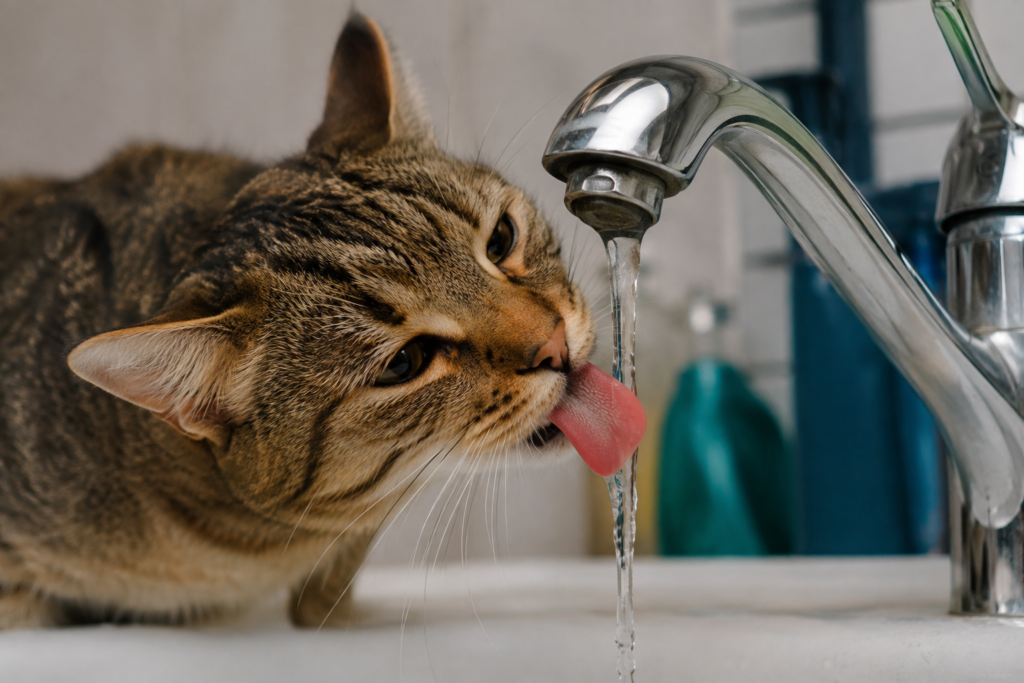
Some cats barely look at a freshly filled water bowl but appear immediately when they hear a tap running. Others paw at the stream, watch the ripples, or choose a circulating fountain over still water.
So, why do cats prefer running water?
For many cats, it is simply an individual preference. Movement, sound, reflections, temperature, bowl design, and location may all influence where a cat chooses to drink. However, research does not show that every cat prefers flowing water or that a fountain reliably improves hydration in all cats.
A long-standing preference for a tap or fountain is usually not concerning by itself. A sudden increase in thirst, especially when accompanied by larger urine clumps, more frequent urination, appetite changes, or weight loss, deserves veterinary attention.
Quick answer: Some cats are attracted to the movement, sound, location, or sensory interest of running water. A fountain can be useful when a cat genuinely prefers it, but it is not automatically better than a clean bowl. The important distinction is between a normal, established preference and a new increase in drinking.
Watch the Short Video
Why Do Cats Prefer Running Water?
A brief veterinary explanation of why some cats choose moving water—and why a sudden change in thirst should not be dismissed as a new habit.
Why Do Some Cats Like Running Water?
There is no single explanation that applies to every cat. The preference is likely influenced by several sensory and environmental factors rather than one universal instinct.
1. Movement may make the water more noticeable
A completely still surface can be visually subtle. Ripples, falling droplets, and reflections create movement that may attract a cat’s attention and encourage investigation. The sound of a tap or fountain can also make the water source easier to locate.
This is a reasonable explanation for the behavior, but it should not be presented as a proven rule for all cats. Scientific studies have mainly examined how much cats drink from different water systems, not the exact psychological reason each cat chooses one source over another.
2. Some cats enjoy the sensory experience
Running water provides more than hydration. A cat may watch it, touch it with a paw, follow droplets, or interact with the stream before drinking. In these cases, the water source may provide mild environmental stimulation as well as access to water.
A cat that repeatedly plays with a fountain is not necessarily dehydrated. The behavior may be exploratory, playful, or part of a familiar routine.
3. Temperature and location may influence preference
Water from a tap may feel cooler than water that has been standing in a warm room. A fountain may also be placed in a quieter, more accessible location than the original bowl.
Sometimes owners assume that the cat prefers “running water” when the real preference is for:
- a quieter drinking area;
- a wider or shallower container;
- water positioned away from food;
- a source that is easier to access;
- cooler or more recently replaced water;
- a location where another cat cannot block access.
4. Cats can develop strong individual habits
Cats often create predictable routines around resources. A cat may learn that sitting near the sink causes a person to turn on the tap. The behavior can then become part of a social interaction as well as a drinking preference.
One cat may prefer a fountain, another may prefer a ceramic bowl, and a third may drink from both without showing a strong preference. Individual behavior is more informative than broad claims about what all cats are supposed to like.
Do All Cats Prefer Running Water?
No. The idea that cats naturally reject still water and universally prefer moving water is too simplistic.
In a small study of healthy pet cats, water intake was slightly higher when a fountain was offered, but the difference did not produce a meaningful improvement in urine concentration. The researchers concluded that the fountain did not substantially increase water intake or dilute urine in that group.
A later controlled study compared still, circulating, and free-falling water systems in healthy cats. Average daily water intake did not differ significantly between the three systems. A few individual cats showed clear preferences, but there was no single presentation method that worked best for every cat.
| What research found | What it means for owners |
|---|---|
| Some individual cats prefer a particular water source. | Offer choices and observe your own cat. |
| Fountains do not consistently increase intake across all cats. | Do not rely on a fountain alone when increased hydration is medically important. |
| Water-source type has less influence than several dietary factors. | Dietary moisture may be more effective than changing the bowl. |
| Normal water intake varies widely. | Changes from the cat’s own baseline matter more than one universal number. |
Is a Cat Water Fountain Better Than a Bowl?
A fountain may be useful when a cat genuinely prefers moving water, but a clean, accessible bowl can be equally appropriate.
The best water source is the one your cat uses comfortably, consistently, and safely.
A fountain may be helpful when:
- your cat repeatedly seeks running taps;
- your cat actively chooses moving water when both options are available;
- the fountain provides an additional drinking location;
- the device is quiet enough that it does not frighten the cat;
- all parts can be dismantled and cleaned properly;
- a veterinarian has recommended strategies to encourage water intake.
A normal bowl may be the better choice when:
- your cat avoids or appears worried by the fountain;
- the pump noise causes hesitation;
- your cat strongly prefers a familiar container;
- the fountain is difficult to clean thoroughly;
- the electrical cable cannot be positioned safely;
- your cat already drinks normally from a bowl.
A fountain should be introduced as an additional option, not as a forced replacement. Keep the familiar bowl available while the cat investigates the new source.
Does a Water Fountain Improve Hydration?
It may help an individual cat, but it is not a guaranteed solution.
A 2025 scoping review covering 32 publications found that feline water intake varied widely and was influenced by diet format, protein and amino-acid content, salt, osmolytes, and water viscosity. Across several groups of healthy cats, reported total water intake was approximately 23–51 ml/kg of body weight per day.
That figure requires careful interpretation. Total water intake includes moisture obtained from food, not only water drunk from a bowl. A cat eating wet food may drink visibly less because a substantial portion of its water is already present in the diet. A cat eating dry food may obtain a larger proportion from drinking water.
The same review found that static versus flowing water did not consistently change intake. This supports a practical conclusion: a fountain can be one useful option, but it should not be considered a universal hydration treatment.
Important: Do not use a single online “normal water intake” number to diagnose your cat. Diet, body size, weather, activity, medications, illness, and individual variation all affect water consumption.
A persistent change from your cat’s normal pattern is often more meaningful than an isolated measurement.
How to Set Up Your Cat’s Water Area
The AAFP and ISFM feline environmental guidelines recommend providing multiple and separated key resources. Food, water, litter trays, resting areas, and other important resources should not all be crowded together in one location.
A practical home setup may include:
- at least two water locations;
- physical separation between food and water;
- water positioned well away from litter trays;
- a quiet location away from busy walkways and loud appliances;
- separate access points in multi-cat homes;
- easy access for older cats or cats with reduced mobility;
- one bowl and one fountain when the cat enjoys both.
In a multi-cat household, one cat may unintentionally block another from reaching a shared bowl. Separate water stations reduce competition and allow each cat to drink without approaching another cat closely.
Choosing a bowl
Many cats readily use wide, low-sided bowls. These can make water easy to reach and reduce contact between the face and the sides of the container. However, there is no single perfect shape or material for every cat.
Offer safe, stable options and observe which one your cat chooses. Ceramic, glass, and stainless-steel containers are commonly used because they can be cleaned thoroughly. Replace any cracked or damaged bowl that can no longer be cleaned properly.
How to Keep a Cat Fountain Clean
A fountain is not automatically cleaner than a bowl. Water movement does not sterilize the reservoir, pump, tubing, filter housing, or drinking surface.
Saliva, hair, food particles, dust, and debris can collect in areas that are not visible from the top. Simply adding fresh water to the reservoir is not the same as cleaning the device.
For safer routine use:
- replace the water regularly rather than topping up old water indefinitely;
- wash the reservoir and drinking surfaces thoroughly;
- remove and clean the pump according to the manufacturer’s instructions;
- check small channels, corners, and filter housings for residue;
- replace filters on the recommended schedule;
- rinse cleaning products away completely before reassembly;
- inspect the cable, plug, and pump for damage;
- stop using the fountain if contamination or electrical damage cannot be corrected.
If the fountain is difficult to dismantle or contains areas you cannot clean, a simple bowl may be the more hygienic and practical option.
How to Encourage a Cat to Take In More Water
When a veterinarian recommends increasing water intake, the best approach usually combines several strategies rather than relying on one product.
Depending on the individual cat, helpful options may include:
- providing several water stations;
- offering both a bowl and a fountain;
- keeping water fresh and easy to access;
- moving water away from food and litter trays;
- using a wide, stable bowl;
- feeding an appropriate wet diet;
- adding a small amount of water to food when the cat accepts it;
- reducing competition between cats;
- placing water near the cat’s preferred resting areas without obstructing them.
Dietary moisture can have a stronger effect on total water intake than switching between a still bowl and a fountain. Cats with urinary disease, chronic kidney disease, diabetes, heart disease, or another medical condition may need an individualized nutrition and hydration plan.
Do not make a major dietary change or dilute a therapeutic diet without discussing it with your veterinarian. A hydration strategy is only useful if the cat continues to eat enough of an appropriate diet.
When Is Drinking From a Tap Normal?
The behavior is usually less concerning when:
- the cat has always preferred running water;
- the amount consumed has not noticeably increased;
- urination appears unchanged;
- appetite and body weight are stable;
- the cat remains active and behaves normally;
- there is no vomiting, weakness, or change in grooming;
- the preference occurs as part of a familiar routine.
A cat may wait near a tap because of habit, curiosity, owner interaction, or preference for that specific location. The presence of the behavior alone does not diagnose dehydration or disease.
When Can Increased Thirst Be a Warning Sign?
A new interest in taps or fountains sometimes becomes noticeable because the cat is genuinely drinking more.
Veterinarians use the terms polydipsia for excessive thirst and polyuria for increased urine production. Owners may first notice these changes as:
- more frequent visits to the water;
- a bowl emptying faster than usual;
- waiting near taps more often;
- larger litter clumps;
- more numerous urine clumps;
- urine appearing outside the litter tray;
- a heavier, wetter litter tray;
- increased demand for fresh water.
Arrange a veterinary examination when increased drinking is sudden, persistent, or accompanied by:
- weight loss;
- increased or reduced appetite;
- vomiting or diarrhea;
- weakness or reduced activity;
- an unkempt coat;
- changes in behavior or vocalization;
- difficulty jumping or moving;
- dehydration;
- changes in urination.
Veterinary warning: A familiar preference for running water is usually behavioral. A sudden increase in thirst or urination is a medical sign that should be investigated rather than suppressed.
Medical Conditions That Can Increase Thirst in Cats
Several diseases can cause increased drinking and urination. The pattern is not specific enough to identify the cause at home, but three important conditions are especially relevant in adult and older cats.
Chronic kidney disease
Chronic kidney disease is common in older cats. Reduced urine-concentrating ability can lead to increased urine production and compensatory thirst. Other possible signs include weight loss, reduced appetite, nausea, vomiting, dehydration, poor coat condition, and reduced activity.
The ISFM chronic kidney disease guidelines emphasize that weight loss, poor body condition, increased thirst and urination, dehydration, and changes in urine concentration may be associated with feline kidney disease. Diagnosis requires veterinary assessment rather than observation of drinking behavior alone.
Diabetes mellitus
The classic signs of feline diabetes include increased urination, increased thirst, weight loss, and often increased appetite. Glucose in the urine draws additional water with it, increasing urine volume and causing compensatory drinking.
Some diabetic cats may later become weak, stop eating, vomit, or develop a plantigrade stance in which the hocks are carried unusually low. These signs require prompt veterinary care.
Hyperthyroidism
Hyperthyroidism is most often diagnosed in middle-aged and older cats. Common signs include weight loss despite a strong appetite, increased activity or restlessness, vomiting, diarrhea, increased vocalization, and increased thirst and urination.
AAFP guidelines specifically note that some owners first recognize thirst when an older cat begins drinking from a dripping faucet or other unusual water source.
Other possible causes of increased thirst include urinary disease, liver disease, certain medications, electrolyte abnormalities, fever, gastrointestinal losses, and less common hormonal or metabolic disorders. Only an examination and appropriate testing can identify the cause.
For more guidance on subtle illness behavior, read the Pawsvexa article Why Cats Hide Pain: Warning Signs Owners May Miss.
What May Happen at the Veterinary Visit?
The veterinarian will usually begin with the history and physical examination. Useful information includes when the change started, whether appetite has changed, body-weight trends, urine-clump size, diet type, medications, vomiting, stool changes, and access to other water sources.
Depending on the cat’s age and clinical signs, the assessment may include:
- body weight and body-condition evaluation;
- hydration assessment;
- blood pressure measurement;
- complete blood count;
- serum biochemistry;
- blood glucose measurement;
- thyroid hormone testing;
- urinalysis and urine specific gravity;
- urine culture when indicated;
- diagnostic imaging or additional testing.
Stress can temporarily raise blood glucose in cats, so diabetes is not diagnosed from one elevated value alone. Veterinary interpretation considers clinical signs, persistent hyperglycemia, urine glucose, and sometimes additional markers.
How to Monitor Your Cat’s Drinking at Home
Exact measurement can be difficult, especially when several pets share water sources or when the cat eats wet food. Still, a simple home record can help identify a meaningful trend.
Track changes, not just numbers
Record:
- how often the bowl or fountain needs refilling;
- the approximate amount added each day;
- how often the cat visits the water;
- the size and number of urine clumps;
- body weight when you can measure it safely;
- appetite and food intake;
- vomiting, diarrhea, or changes in activity;
- any medications or diet changes.
When practical, measure the amount placed in the bowl and the amount remaining 24 hours later. Account for spills, evaporation, other pets, outdoor drinking, and water contained in food.
A short video of unusual drinking behavior and several days of written notes may be useful during the veterinary consultation.
Never restrict access to water in an attempt to reduce urination unless a veterinarian has provided a specific medical instruction.
Common Myths About Cats and Running Water
“Running water is always safer than still water.”
Not necessarily. A neglected fountain can contain debris and residue just like an unwashed bowl. Cleanliness depends on maintenance, not movement alone.
“Every cat needs a fountain.”
No. Some cats strongly prefer fountains, some prefer still water, and many use both. Research has not identified one water system that consistently works best for all cats.
“Cats prefer running water because wild water is always safer.”
This popular explanation is often repeated as fact, but it is not established as a universal scientific rule. Modern pet cats show considerable individual variation, and preference may be influenced by movement, sound, location, temperature, learning, and routine.
“A fountain prevents kidney or urinary disease.”
A fountain alone cannot prevent these diseases. Hydration is important, but health also depends on diet, age, genetics, body condition, medical history, and veterinary care.
“A cat drinking from the tap must be dehydrated.”
Not always. It may be a normal preference. The key question is whether thirst, urination, appetite, weight, or behavior has changed.
“Cats eating wet food do not need drinking water.”
Incorrect. Fresh drinking water should always remain available, even when most dietary moisture comes from food.
Frequently Asked Questions
Why does my cat ignore the bowl but drink from the faucet?
The movement, sound, temperature, location, or shape of the drinking area may be more appealing. The bowl may also be placed near food, litter, noise, or another cat. Offer several clean water sources in quiet locations and observe the cat’s preference.
Are cat water fountains worth buying?
They can be worthwhile when a cat prefers moving water and the fountain is easy to clean. They are not essential for every cat and should not replace veterinary assessment when thirst has increased.
Do cats drink more from fountains?
Some individual cats may, but controlled studies have not found a consistent increase across all cats. Personal preference matters more than the assumption that fountains are universally superior.
How often should I change the water?
Keep water fresh and replace it whenever it becomes contaminated with food, saliva, hair, or debris. Fountains also require thorough cleaning of the reservoir, pump, channels, and filter system according to the manufacturer’s instructions.
Why is my older cat suddenly drinking from the tap?
A new increase in thirst in an older cat should be investigated. Chronic kidney disease, diabetes mellitus, and hyperthyroidism are among the conditions that can cause increased drinking, urination, and weight change.
Should I stop my cat from drinking from the tap?
Not necessarily, provided the water is safe and the environment presents no risk. Continue offering accessible bowls or a fountain so the cat is not dependent on someone turning on the tap.
Can a cat drink too much water?
Excessive drinking is usually a sign to investigate rather than a behavior to suppress. Do not restrict water. Arrange a veterinary examination when the change is sudden, persistent, or associated with other signs.
Is a wide bowl better for cats?
Some cats appear more comfortable using wide, low-sided bowls, but preferences vary. Offer stable, easy-to-clean options and allow the cat to choose.
The Pawsvexa Takeaway
Some cats prefer running water because the movement, sound, location, temperature, or interaction attracts them. Others are completely satisfied with a normal bowl.
A clean fountain can be a useful additional water source, but it is not automatically better and does not guarantee improved hydration. Offer choices, separate important resources, keep every water source clean, and observe what your cat actually uses.
Most importantly, distinguish a long-standing preference from a genuine change in thirst.
If your cat suddenly drinks more, urinates more, loses weight, develops an appetite change, vomits, becomes weak, or behaves differently, arrange a veterinary assessment rather than assuming the cat has simply discovered a new favorite water source.
Would You Recognize a Pet Emergency?
Get the free Pawsvexa checklist with 12 warning signs every dog and cat owner should know.
Free to download. Created by a qualified veterinarian.
Sources and Further Reading
- Grant DC. Effect of water source on intake and urine concentration in healthy cats. Journal of Feline Medicine and Surgery. 2010. PubMed
- Robbins MT, Cline MG, Bartges JW. Quantified water intake in laboratory cats from still, free-falling and circulating water bowls, and its effects on selected urinary parameters. Journal of Feline Medicine and Surgery. 2019. PubMed
- Kosmal PAL, Shoveller AK. Diet format, protein, amino acids, salt, osmolytes and water viscosity affect water consumption in domestic cats: a scoping review of 32 publications from 1975 to 2025. Journal of Animal Science. 2025. Full text
- Ellis SLH, Rodan I, Carney HC, et al. AAFP and ISFM Feline Environmental Needs Guidelines. Journal of Feline Medicine and Surgery. 2013. Full text
- Sparkes AH, Caney S, Chalhoub S, et al. ISFM Consensus Guidelines on the Diagnosis and Management of Feline Chronic Kidney Disease. Journal of Feline Medicine and Surgery. 2016. Full text
- iCatCare. Consensus Guidelines on the Diagnosis and Management of Diabetes Mellitus in Cats. Journal of Feline Medicine and Surgery. 2025. Full text
- Carney HC, Ward CR, Bailey SJ, et al. 2016 AAFP Guidelines for the Management of Feline Hyperthyroidism. Journal of Feline Medicine and Surgery. 2016. Full text
- Quimby J, Gowland S, Carney HC, et al. 2021 AAFP Feline Senior Care Guidelines. Journal of Feline Medicine and Surgery. 2021. Full text
Written by a veterinarian for Pawsvexa.
This article is intended for general educational purposes and does not replace a veterinary examination, diagnosis, or individualized treatment plan.