
Written by a qualified veterinarian.
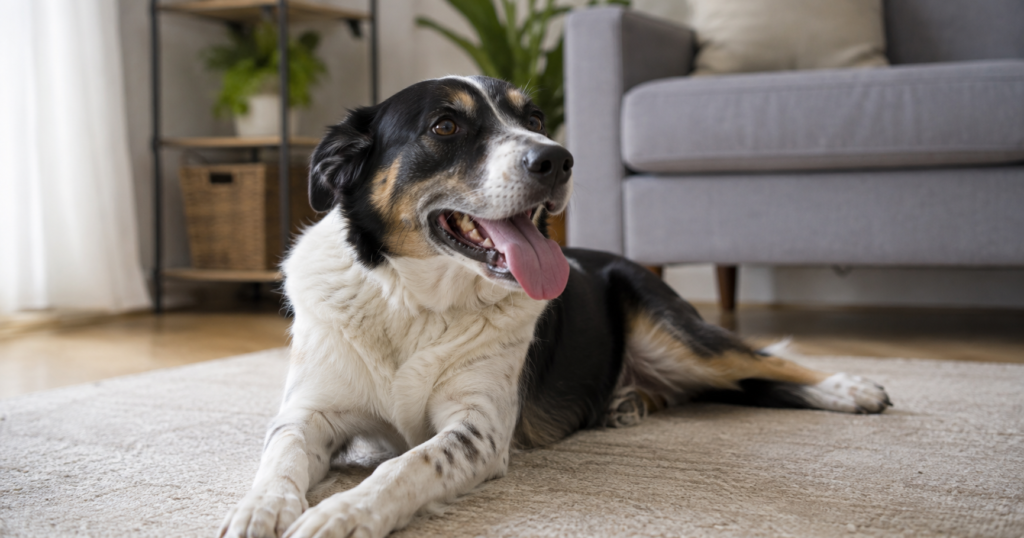
Dogs commonly pant after running, playing, becoming excited, or spending time in a warm environment. In these situations, panting helps release heat and may settle once the dog rests and becomes calm.
But why is your dog panting when it isn’t hot?
Panting in cool conditions is not automatically abnormal. Exercise, excitement, fear, stress, and temporary emotional arousal can all cause a dog to breathe with an open mouth. However, panting that begins while the dog is resting, continues without an obvious reason, becomes more intense, or appears alongside weakness, pain, coughing, or difficulty breathing should not be ignored.
The most useful question is not simply whether the weather is hot. It is whether the panting makes sense for the situation and whether it is different from your dog’s usual pattern.
Quick answer: A dog may pant when it is not hot because of recent exercise, excitement, stress, anxiety, pain, medication effects, hormonal disease, fever, or a heart, lung, or airway problem. Panting that is persistent at rest, unusually intense, or accompanied by labored breathing, pale or blue gums, weakness, or collapse requires prompt veterinary attention.
Watch the Short Video
Why Is My Dog Panting When It Isn’t Hot?
A brief veterinary explanation of when panting can be normal and when panting at rest may be associated with pain or a breathing problem.
What Is Panting?
Panting is rapid, shallow, open-mouth breathing. It is an important cooling mechanism because dogs do not regulate body temperature by sweating across most of their skin in the same way people do.
During panting, air moves quickly over moist surfaces in the mouth and upper airways. Evaporation helps release heat from the body. Panting may therefore increase during exercise, warm weather, excitement, or any situation that raises body temperature or metabolic activity.
However, panting is not controlled by temperature alone. Emotional arousal, pain, medications, hormonal changes, and disturbances involving the heart, lungs, airways, blood, or nervous system may also influence breathing.
This is why panting must always be interpreted in context.
When Panting Can Be Normal
Panting is often expected when it has a clear cause, remains proportionate to that cause, and settles once the trigger has passed.
1. Recent exercise
A dog may pant after walking, running, playing, swimming, training, or climbing stairs. Physical activity produces heat, even when the outdoor temperature is cool.
The breathing should gradually become quieter as the dog rests. The exact recovery time varies with fitness, body condition, breed, age, intensity of activity, and health status.
A fit adult dog may recover quickly after moderate exercise. An older dog, an overweight dog, a flat-faced breed, or a dog with heart or airway disease may take longer and may tolerate activity less well.
2. Excitement
Some dogs pant when visitors arrive, before a walk, during a car journey, at a training class, or when anticipating food or play.
Excitement activates the sympathetic nervous system and may temporarily increase heart rate, breathing rate, movement, vocalization, and panting.
This type of panting usually improves when the dog becomes calm and the exciting event ends.
3. Stress, fear, or anxiety
Panting may occur during thunderstorms, fireworks, travel, veterinary visits, separation, unfamiliar social situations, or exposure to something the dog finds frightening.
Other signs may include:
- pacing;
- trembling;
- lip licking;
- yawning;
- drooling;
- whining;
- ears held back;
- attempting to hide or escape;
- showing the whites of the eyes;
- difficulty settling.
Do not assume that all unexplained panting is anxiety. Pain and medical disease can produce similar changes, especially when the behavior is new.
4. A warm indoor environment
A room, car, conservatory, enclosed bed, thick coat, warm flooring, or direct sunlight may make a dog hot even when the outdoor temperature does not seem high.
Heavy blankets, poor ventilation, obesity, recent activity, and high humidity can also reduce the dog’s ability to release heat efficiently.
Why Is My Dog Panting at Rest?
Panting at rest deserves closer attention because the dog is not actively producing heat through exercise.
It may still have a harmless explanation. The dog could be excited, anxious, recently active, or lying in a warm area. However, persistent or unusual panting at rest can also occur with pain, fever, medication effects, hormonal disease, anemia, airway obstruction, heart disease, lung disease, or another systemic problem.
The presence of panting alone does not identify the cause. Look at the entire dog, the circumstances, and whether the behavior is changing.
Common Reasons a Dog Pants When It Is Not Hot
Pain or physical discomfort
Excessive panting at rest can be a sign of pain. Dogs may pant because they are uncomfortable after an injury, surgical procedure, abdominal problem, dental problem, spinal condition, arthritis flare, or another painful process.
Possible accompanying signs include:
- restlessness or repeated position changes;
- difficulty lying down or standing up;
- reluctance to walk, jump, or climb stairs;
- limping or stiffness;
- a hunched posture;
- trembling;
- whimpering or unusual vocalization;
- reduced appetite;
- guarding part of the body;
- reacting when touched;
- withdrawal or irritability;
- an inability to sleep comfortably.
Pain-related panting may be subtle. Some dogs do not cry or limp even when they are significantly uncomfortable.
Important: Never give ibuprofen, naproxen, acetaminophen, aspirin, or another human pain medication unless your veterinarian has specifically prescribed an appropriate product and dose for your dog. Several common human medicines can cause severe or fatal toxicity in dogs.
Stress or anxiety
Stress-related panting often appears in a recognizable situation. A dog may pant during a storm, in a car, at the veterinary clinic, after a household change, or when left alone.
However, anxiety should not be used as a default explanation for a new medical sign. A dog that begins panting at night, becomes unable to settle, or behaves differently should be assessed for pain and illness as well as behavioral causes.
Fever or systemic illness
Infection and inflammation may raise body temperature or metabolic demand. A sick dog may pant even in a cool room.
Other possible signs include:
- lethargy;
- reduced appetite;
- vomiting or diarrhea;
- coughing;
- nasal discharge;
- shivering;
- weakness;
- changes in drinking or urination.
A warm or dry nose is not a reliable way to diagnose fever. Body temperature must be measured correctly, and the result should be interpreted with the dog’s overall condition.
Medication effects
Some medications can increase panting. Corticosteroids such as prednisone are a common example. Dogs receiving these medications may also drink more, urinate more, appear hungrier, or become restless.
Medication-related panting does not mean the treatment should be stopped suddenly. Abruptly discontinuing certain drugs, especially corticosteroids after continued use, may be dangerous.
Contact the prescribing veterinarian when:
- panting begins after a new medication;
- the panting becomes difficult to tolerate;
- other side effects develop;
- the dose has recently changed;
- you are uncertain whether the reaction is expected.
Cushing syndrome
Hyperadrenocorticism, commonly called Cushing syndrome, causes prolonged exposure to excessive cortisol. It is more common in middle-aged and older dogs.
Possible signs include:
- increased panting;
- increased thirst and urination;
- increased appetite;
- a pendulous or pot-bellied abdomen;
- muscle weakness or wasting;
- thin skin;
- hair loss;
- recurrent skin infections;
- reduced exercise tolerance.
Panting alone is not enough to diagnose Cushing syndrome. Diagnosis requires the history, physical examination, laboratory testing, and sometimes diagnostic imaging.
Obesity and poor physical conditioning
Excess body weight increases the effort required for movement and may make heat dissipation less efficient. Overweight dogs may pant after activity that would produce little visible effort in a lean, conditioned dog.
Obesity can also worsen airway, joint, and cardiovascular problems.
A gradual veterinary-supervised weight plan may improve mobility, exercise tolerance, comfort, and general health.
Brachycephalic airway problems
Flat-faced breeds such as Bulldogs, French Bulldogs, Pugs, Boston Terriers, and Pekingese may have narrowed nostrils, an elongated soft palate, a narrow windpipe, or other anatomical changes that restrict airflow.
These dogs may:
- pant heavily with minimal activity;
- snore or breathe noisily;
- gag or retch;
- struggle in warm or humid conditions;
- sleep poorly;
- become distressed with excitement;
- develop blue gums or collapse in severe cases.
Noisy breathing should not automatically be accepted as normal simply because of the dog’s breed. Affected dogs may need airway assessment and a specific management plan.
Laryngeal paralysis
Laryngeal paralysis affects the opening of the larynx and can restrict airflow. It is commonly recognized in older, medium-to-large dogs, although other dogs can be affected.
Signs may include:
- increased panting;
- noisy, raspy, or harsh breathing;
- a change in the bark;
- coughing or gagging;
- poor exercise tolerance;
- difficulty breathing;
- blue gums or tongue;
- collapse.
Symptoms often worsen with exercise, heat, humidity, stress, or excitement.
Heart disease
Heart disease can reduce the efficiency of circulation and may lead to fluid accumulation in or around the lungs. Some affected dogs develop increased breathing at rest, coughing, reduced stamina, weakness, or collapse.
Possible warning signs include:
- faster breathing while sleeping;
- panting without a clear trigger;
- coughing, especially at night or after activity;
- reduced willingness to exercise;
- weakness or fainting;
- abdominal enlargement;
- restlessness when trying to sleep.
Not every coughing or panting dog has heart disease. Veterinary examination is needed to distinguish cardiac disease from airway, lung, pain, behavioral, and other causes.
Lung or lower-airway disease
Pneumonia, bronchitis, pulmonary edema, cancer, parasites, inflammation, bleeding, or other lung disorders may impair oxygen exchange.
Affected dogs may show:
- rapid or labored breathing;
- coughing;
- fever;
- lethargy;
- reduced appetite;
- exercise intolerance;
- abnormal breathing sounds;
- pale, gray, or blue gums.
Respiratory disease can progress quickly. Do not wait for a dog with visible breathing effort to “sleep it off.”
Anemia or blood loss
Red blood cells carry oxygen. When a dog is severely anemic, the body may compensate by increasing heart rate and breathing effort.
Potential signs include:
- pale gums;
- weakness;
- rapid breathing;
- reduced stamina;
- collapse;
- dark stool;
- visible bleeding;
- abdominal enlargement in some internal bleeding cases.
Sudden pallor, weakness, or collapse is an emergency.
Abdominal enlargement or pressure
A swollen or painful abdomen can limit comfortable breathing and cause restlessness or panting. Causes range from gastrointestinal discomfort to internal bleeding, organ enlargement, fluid accumulation, or gastric dilatation-volvulus.
Seek emergency care when panting is accompanied by:
- a rapidly enlarging abdomen;
- repeated unproductive retching;
- drooling;
- severe restlessness;
- weakness;
- pale gums;
- collapse.
Is Panting the Same as Labored Breathing?
No. Panting and respiratory distress can both involve open-mouth breathing, but they are not the same.
A normally panting dog usually remains alert, can move air without obvious struggle, and gradually settles after rest or removal of the trigger.
A dog in respiratory distress may appear unable to move enough air despite increased effort.
| More consistent with ordinary panting | More concerning for respiratory distress |
|---|---|
| Clear trigger such as exercise or excitement | Begins at rest without a clear trigger |
| Breathing gradually settles with calm rest | Breathing remains intense or becomes worse |
| No obvious abdominal effort | Abdomen visibly pushes with each breath |
| Normal pink gums | Pale, gray, purple, or blue gums |
| Dog remains comfortable and responsive | Dog appears distressed, weak, or unable to settle |
| Normal posture | Neck extended, elbows held out, or refusal to lie down |
Emergency Warning Signs
Breathing difficulty is a medical emergency. Go to the nearest emergency veterinary hospital when panting or heavy breathing is accompanied by any of the following:
- obvious effort or struggle with each breath;
- strong abdominal movement during breathing;
- the head and neck extended to improve airflow;
- elbows held away from the chest;
- an inability or refusal to lie down;
- blue, purple, gray, or very pale gums;
- weakness, wobbling, fainting, or collapse;
- loud wheezing, whistling, or harsh airway noise;
- a rapidly swollen abdomen;
- repeated unproductive retching;
- suspected heatstroke;
- major trauma;
- known heart or lung disease with worsening breathing.
Veterinary emergency: If your dog is visibly struggling to breathe, do not spend several minutes counting breaths, searching online, offering food, or trying home remedies.
Keep the dog calm, minimize handling, use air conditioning during transport, call the emergency clinic while travelling when possible, and seek immediate veterinary care.
How to Check Your Dog at Home
Home observation can provide useful information when the dog is comfortable and not showing emergency signs.
Remove obvious triggers
Stop exercise and move the dog to a quiet, cool, well-ventilated location. Allow unrestricted access to fresh water, but do not force the dog to drink.
Reduce excitement, noise, handling, and interaction with other animals.
Observe whether the panting settles
Watch the dog from a short distance. Note:
- when the panting began;
- what happened immediately beforehand;
- whether it is improving;
- whether the dog can lie down comfortably;
- whether the breathing appears effortless or strained;
- whether coughing, gagging, trembling, or weakness is present.
Look at the gum color
When it is safe and does not upset the dog, lift the lip briefly and look at the gums.
Healthy gum color is commonly pink, although normal pigmentation varies between dogs. Pale, white, gray, purple, or blue mucous membranes are concerning, especially when combined with weakness or breathing difficulty.
Do not repeatedly handle the mouth of a distressed dog. Stress can worsen breathing.
Count the resting or sleeping respiratory rate
The best time to count breathing is when the dog is fully relaxed or asleep and is not panting.
One rise and fall of the chest equals one breath. Count for 30 seconds and multiply by two.
Many healthy resting dogs breathe approximately 12–30 times per minute. A rate consistently above the dog’s normal baseline, especially above approximately 30 breaths per minute while sleeping, should be discussed with a veterinarian.
A breathing rate should never be interpreted alone. Visible effort, abnormal gum color, weakness, or distress is more urgent than the number itself.
Record a short video
A video can help the veterinarian assess:
- the breathing pattern;
- the dog’s posture;
- abdominal effort;
- airway sounds;
- the circumstances in which the panting occurs.
Record from a safe distance without delaying urgent care.
When to Arrange a Non-Emergency Veterinary Examination
Book an examination when:
- panting at rest is new or recurring;
- the dog pants more than usual during mild activity;
- recovery after exercise takes longer than before;
- panting regularly interrupts sleep;
- the dog appears painful or restless;
- there is new coughing, gagging, or noisy breathing;
- appetite, weight, thirst, or urination has changed;
- the dog is receiving medication that may influence panting;
- the dog is older and the behavior has changed;
- you cannot identify a reasonable trigger.
An examination is particularly important when panting is part of a broader pattern rather than an isolated event.
What May Happen at the Veterinary Visit?
The veterinarian will first determine whether the dog is stable and whether the problem appears to involve pain, body temperature, the upper airway, the lungs, the heart, blood circulation, or another body system.
Useful history includes:
- when the panting started;
- whether it occurs at rest, during sleep, or after activity;
- how long each episode lasts;
- recent heat exposure or exercise;
- coughing, gagging, vomiting, or diarrhea;
- changes in appetite, weight, thirst, or urination;
- recent injury or surgery;
- current medications and supplements;
- previous heart, lung, airway, hormonal, or pain conditions.
Depending on the findings, testing may include:
- body temperature;
- heart and lung auscultation;
- oxygen measurement;
- blood pressure;
- complete blood count;
- serum biochemistry;
- urinalysis;
- chest radiographs;
- airway examination;
- heart ultrasound or electrocardiography;
- hormonal testing;
- abdominal imaging;
- additional tests guided by the examination.
Dogs in respiratory distress may need oxygen and stabilization before diagnostic procedures are attempted.
What Not to Do
- Do not force exercise to see whether the dog “walks it off.”
- Do not muzzle a dog that is struggling to breathe.
- Do not force food, water, or medication into a distressed dog.
- Do not give human painkillers.
- Do not stop prescribed corticosteroids suddenly without veterinary advice.
- Do not place ice directly over the entire body.
- Do not delay emergency transport to take repeated measurements.
- Do not assume panting is anxiety when the behavior is new.
- Do not assume noisy breathing is normal for a flat-faced breed.
Can Panting Be Worse at Night?
Night-time panting may be more noticeable because the house is quiet and the dog is expected to rest.
Possible explanations include:
- pain becoming more apparent after activity;
- anxiety or cognitive changes;
- a warm sleeping area;
- medication effects;
- heart or lung disease;
- hormonal disease;
- an inability to find a comfortable position;
- the need to urinate more frequently.
Repeated night-time panting, pacing, or inability to sleep should be investigated, especially in an older dog.
Can Older Dogs Pant More?
Older dogs may pant more because age increases the likelihood of arthritis, spinal pain, heart disease, airway disease, hormonal disorders, obesity, reduced fitness, and cognitive changes.
Age itself should not be used as the diagnosis. A new change in an older dog still deserves assessment.
Keep a record of:
- sleep quality;
- mobility;
- exercise tolerance;
- appetite;
- body weight;
- drinking and urination;
- coughing;
- panting episodes;
- current medications.
These details can help identify patterns that are difficult to reproduce during a clinic visit.
How to Reduce Normal Panting Triggers
When medical disease has been excluded or appropriately managed, practical changes may reduce avoidable panting.
- Exercise during cooler parts of the day.
- Build fitness gradually rather than suddenly increasing activity.
- Maintain a healthy body condition.
- Provide shade, ventilation, and fresh water.
- Avoid leaving dogs in parked vehicles.
- Use calm, predictable routines for anxious dogs.
- Introduce travel and new environments gradually.
- Give flat-faced dogs additional protection from heat, humidity, and overexertion.
- Follow the veterinarian’s treatment plan for pain, heart disease, airway disease, or hormonal conditions.
Do not use exercise restriction or cooling strategies as a substitute for diagnosis when panting is unexplained.
Frequently Asked Questions
Why is my dog panting while lying down?
The dog may still be cooling down, feeling excited or anxious, or resting in a warm location. However, panting while lying quietly can also occur with pain, fever, medication effects, heart disease, airway disease, lung disease, or another medical problem. Persistent or new panting at rest should be discussed with a veterinarian.
Why is my dog panting for no apparent reason?
There may be a trigger that is not immediately visible, such as pain, emotional stress, medication effects, increased body temperature, hormonal disease, or reduced oxygen delivery. Record the circumstances and look for other changes rather than assuming there is no cause.
Can pain cause a dog to pant?
Yes. Excessive panting at rest is a recognized sign of pain in dogs. Pain-related panting may occur with restlessness, altered posture, reduced appetite, limping, reluctance to move, trembling, or difficulty sleeping.
Can anxiety make a dog pant?
Yes. Fear, stress, and anxiety may cause panting, pacing, trembling, drooling, lip licking, whining, and difficulty settling. A medical cause should still be considered when the behavior is new or occurs without a recognizable emotional trigger.
Why is my dog panting at night?
Night-time panting may be related to pain, anxiety, warmth, medication effects, increased thirst, cognitive changes, heart disease, airway disease, or another condition. Repeated episodes or an inability to sleep comfortably warrant veterinary assessment.
How long should panting last after exercise?
There is no single normal recovery time for every dog. Panting should gradually improve with calm rest in a cool environment. Seek advice when recovery takes much longer than usual, the dog shows breathing effort, or exercise tolerance has declined.
When is dog panting an emergency?
Panting is an emergency when the dog is struggling to breathe, using the abdomen forcefully, extending the neck, unable to lie down, developing pale or blue gums, becoming weak, or collapsing. Seek immediate emergency veterinary care.
Should I give my dog water while it is panting?
Fresh water should be available, but do not force a dog to drink. A dog in respiratory distress should be handled as little as possible and transported for emergency care.
Can prednisone make a dog pant?
Yes. Corticosteroids such as prednisone can increase panting, thirst, urination, appetite, and restlessness. Contact the prescribing veterinarian if side effects are severe, but do not stop the medication suddenly unless instructed.
Can Cushing syndrome cause panting?
Yes. Increased panting is common in dogs with Cushing syndrome, often alongside increased thirst, urination, appetite, abdominal enlargement, muscle weakness, and skin or coat changes. Veterinary testing is required for diagnosis.
The Pawsvexa Takeaway
Panting is not always caused by hot weather. Dogs may pant after exercise, during excitement, or when they feel stressed, even in a cool environment.
What matters most is whether the panting fits the situation, settles appropriately, and resembles the dog’s normal pattern.
Panting that begins at rest, becomes more intense, repeatedly interrupts sleep, or appears with pain, coughing, weakness, reduced stamina, or other changes deserves veterinary attention.
Visible breathing effort, abdominal movement, an extended neck, pale or blue gums, weakness, or collapse are emergency signs.
When you are uncertain, record a short video, note the circumstances, and contact your veterinarian. Early assessment is safer than waiting for a potentially serious breathing problem to become obvious.
Would You Recognize a Pet Emergency?
Get the free Pawsvexa checklist with 12 warning signs every dog and cat owner should know.
Free to download. Created by a qualified veterinarian.
Sources and Further Reading
-
Cornell University College of Veterinary Medicine. Recognizing and Responding to Canine Respiratory Distress. Updated March 2025.
Cornell University -
Cornell University College of Veterinary Medicine. Recognizing Pain in Dogs.
Cornell University -
Cornell University College of Veterinary Medicine. Anxious Behavior: How to Help Your Dog Cope With Unsettling Situations.
Cornell University -
Merck Veterinary Manual. Initial Triage and Resuscitation of Small Animal Emergency Patients.
Merck Veterinary Manual -
Merck Veterinary Manual. Clinical Signs of Respiratory Disease in Animals.
Merck Veterinary Manual -
Merck Veterinary Manual. Cushing Syndrome (Hyperadrenocorticism) in Animals.
Merck Veterinary Manual -
Cornell University College of Veterinary Medicine. Laryngeal Paralysis.
Cornell University -
American Animal Hospital Association. 2022 AAHA Pain Management Guidelines for Dogs and Cats.
AAHA -
Sumner C, Rozanski E. Management of Respiratory Emergencies in Small Animals. Veterinary Clinics of North America: Small Animal Practice. 2013;43(4):799–815.
PubMed -
Boysen SR, Lisciandro GR. Respiratory Distress in Small Animals: Pathophysiology and Clinical Approach. Journal of Veterinary Emergency and Critical Care. 2022.
PubMed
Written by a veterinarian for Pawsvexa.
This article is intended for general educational purposes and does not replace a veterinary examination, diagnosis, emergency assessment, or individualized treatment plan. If your dog is struggling to breathe, seek immediate veterinary care.