
Written by a qualified veterinarian
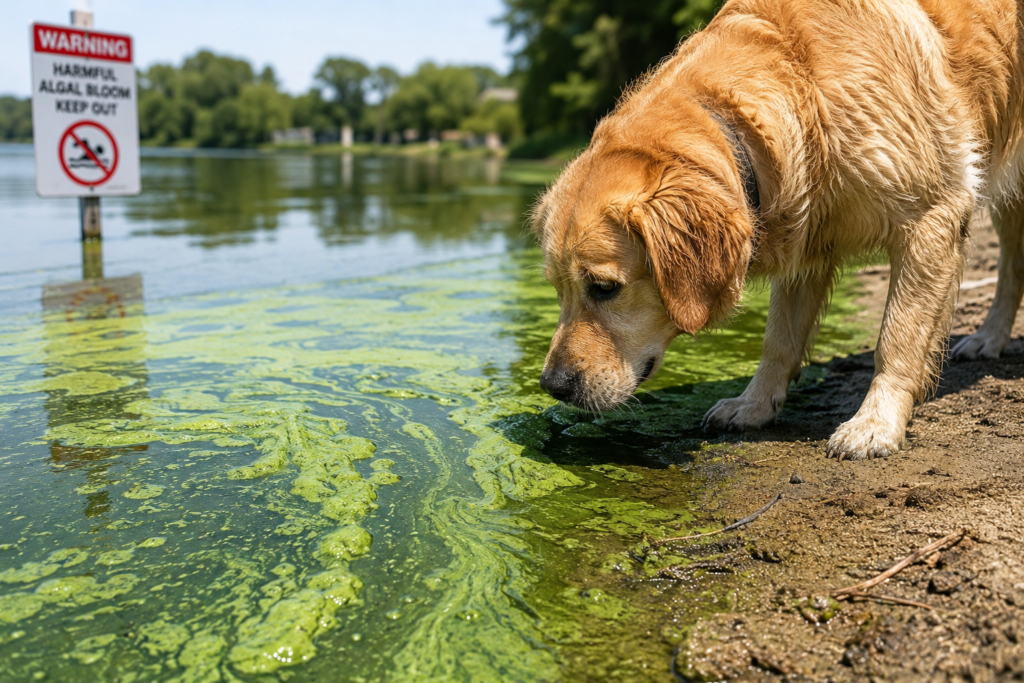
Blue-green algae and dogs can be a dangerous combination. A lake, pond, reservoir, or slow-moving river may look like the perfect place for your dog to swim, but water containing green scum, surface foam, floating mats, streaks, or unusual discoloration may contain cyanobacteria.
Some cyanobacteria can produce powerful toxins capable of causing severe and rapidly developing illness in dogs. Exposure may occur when a dog drinks contaminated water, swallows it while swimming, eats cyanobacterial material near the shoreline, or licks contaminated water from the coat and paws.
Not every cyanobacterial bloom produces toxins, and harmful water cannot be identified reliably by appearance alone. Some dangerous blooms are difficult to see because they grow below the surface. If water looks or smells unusual—or its safety is uncertain—the safest decision is to keep your dog out.[1]
Watch: Never Let Your Dog Swim in Water Like This
Watch the Pawsvexa video below for a quick explanation of the visible warning signs and the immediate steps to take after possible exposure.
Blue-Green Algae and Dogs: What Owners Should Know
Despite the common name, blue-green algae are not true algae. They are microscopic organisms called cyanobacteria. They occur naturally in fresh water and can also be found in salt or brackish water.
Under favorable environmental conditions, cyanobacteria may multiply rapidly and form what is known as a cyanobacterial bloom. Blooms are more likely to develop when water is warm, slow-moving, and rich in nutrients such as nitrogen and phosphorus, although they may occur in many different environments.[1]
Some blooms produce cyanotoxins that can harm people, pets, livestock, wildlife, and aquatic animals. Other blooms may not produce detectable toxins. The problem is that a dog owner cannot determine whether toxins are present simply by looking at the water.
Laboratory analysis may be required to identify the cyanobacteria and toxins involved. Because results are rarely available at the moment a dog approaches the water, prevention must be based on visible warning signs, official advisories, and avoiding uncertain water.
What Is a Harmful Algal Bloom?
A harmful algal bloom, often shortened to HAB, is a rapid growth of algae or cyanobacteria that may harm people, animals, or the surrounding environment.
A bloom may become harmful in more than one way. Some cyanobacteria produce toxins, while a dense bloom can also reduce oxygen levels in the water as organisms die and decompose. This can contribute to fish deaths and other environmental changes.
Visible cyanobacterial material may collect on the surface or along the shoreline. Wind and water movement can concentrate the material into dense patches, which may contain much higher levels of cyanobacteria than the open water nearby.[2]
This is particularly important for dogs because they often investigate material at the water’s edge, retrieve toys near the shoreline, or drink from shallow areas where concentrated scum has accumulated.
Why Dogs May Be at Particular Risk
Understanding the connection between blue-green algae and dogs is important because exposure may occur during ordinary activities such as swimming, retrieving toys, drinking from natural water, or licking wet fur.
Dogs frequently interact with natural water in ways that increase the opportunity for exposure. They may drink directly from lakes or ponds, swallow water while swimming, retrieve balls and sticks, eat material near the shore, and groom themselves immediately afterward.
A dog may therefore be exposed even when the owner never sees it deliberately drink. Water can enter the mouth during swimming, and cyanobacteria or toxins may remain on the coat, paws, collar, harness, or toys.
After leaving the water, the dog may swallow contaminated material by licking its fur. Dogs may also eat floating mats, shoreline scum, algae, dead fish, or other animals that have been exposed to a harmful bloom.[3]
Published reviews of canine cyanotoxin cases have documented illness and deaths after dogs drank contaminated water or groomed cyanobacterial material from their coats following swimming.[4]
Where Can Cyanobacterial Blooms Occur?
Cyanobacteria may occur in many types of water, including:
- Lakes
- Ponds
- Reservoirs
- Rivers
- Slow-moving streams
- Canals
- Decorative ponds
- Farm ponds and livestock water sources
- Brackish water
- Some coastal waters
Warm weather can increase concern, but cyanobacterial risk should not be considered exclusively a summer problem. Local conditions, nutrient levels, sunlight, rainfall, water movement, and temperature all influence bloom development.
Conditions can also change quickly. A location that appeared normal during a previous visit may look different several days—or even several hours—later.
What Can Suspicious Water Look Like?
A visible cyanobacterial bloom may change the color, texture, or surface appearance of the water.
Warning appearances may include:
- Green or blue-green water
- Brown, red, or unusually discolored water
- Surface foam or scum
- Floating mats or clumps
- Dots, streaks, or swirls across the surface
- Material resembling spilled paint
- Thick water resembling pea soup
- Dense green material along the shoreline
- An unusual or unpleasant smell
- Dead fish or other animals near the water
Not all green water is caused by toxic cyanobacteria. Plants, pollen, harmless algae, sediment, and other material can also alter the appearance of water. However, visual inspection cannot reliably distinguish a harmless condition from a toxic bloom.
When the appearance is questionable, the goal is not to identify the organism yourself. The correct decision is to prevent exposure.
Clear-looking water is not always safe
Some harmful cyanobacterial blooms grow below the surface and may be difficult to see. Toxins may also remain in the water even when an obvious surface layer is not present.[1]
For that reason, apparently clear water should not be considered proof of safety when there is an active local advisory, recent bloom report, dead wildlife, or other reason for concern.
Pay attention to official warning signs
Local environmental, public-health, water-management, or municipal authorities may post advisories when harmful blooms are suspected or confirmed.
Never allow a dog to enter water that has been closed to swimming or marked with a harmful-algal-bloom warning. Check current local advisories before visiting unfamiliar recreational water.
How Can Dogs Be Exposed?
Cyanobacteria and their toxins may enter or contact a dog’s body in several ways.
Drinking contaminated water
Direct ingestion is one of the most concerning exposure routes. Dogs may drink voluntarily because they are thirsty, hot, excited, or unfamiliar with the danger.
Concentrated surface scum or shoreline material may contain a higher level of cyanobacteria than the surrounding water. Even a relatively small amount may be clinically important when highly concentrated material is swallowed.
Swallowing water while swimming
A dog does not have to stop and drink from the shore. Water may be swallowed during swimming, retrieving, splashing, or holding a toy in the mouth.
Licking contaminated fur
Cyanobacteria or toxins can remain on the coat and paws. Grooming after swimming may turn an external exposure into an oral exposure.
This is why dogs should not be allowed to lick themselves before they are rinsed with clean tap water after possible contact.[3]
Eating cyanobacterial mats or shoreline material
Some dogs investigate or eat floating material, dried mats, or scum deposited along the shore. Concentrated material may present a particularly serious risk.
Eating dead fish or other animals
Dogs should not be allowed to eat fish, birds, or other animals found dead in or near suspicious water. Exposure to harmful algal toxins may occur through contaminated animals as well as through the water itself.
Skin, eye, or respiratory exposure
Direct contact may cause skin or eye irritation in some animals. Fine water droplets or aerosols may also be inhaled near affected water, although ingestion remains an especially important route in dogs.[1]
Which Toxins Can Affect Dogs?
Cyanobacteria may produce different toxins with different effects on the body. The clinical pattern depends on the specific toxin, the amount involved, the route of exposure, and the individual dog.
Cyanotoxins of veterinary importance include hepatotoxins that primarily damage the liver, neurotoxins that interfere with the nervous system or breathing, and toxins that may affect the kidneys, skin, or other tissues.[5]
Microcystins and other hepatotoxins
Microcystins are important cyanobacterial toxins associated with severe liver injury. After absorption, they may damage liver cells and interfere with normal liver function.
Affected dogs may initially show vomiting, diarrhea, drooling, weakness, loss of appetite, abdominal discomfort, or collapse. More advanced signs may include jaundice, dark urine, abnormal bleeding, or rapidly developing liver failure.
Published veterinary cases have documented severe and fatal liver injury in dogs after suspected or confirmed exposure to microcystin-producing blooms.[6]
Anatoxin-a, saxitoxins, and other neurotoxins
Some cyanobacterial neurotoxins interfere with the communication between nerves and muscles. This may cause weakness, loss of coordination, muscle twitching, tremors, seizures, paralysis, respiratory failure, or sudden death.
Neurologic intoxication may progress extremely quickly. In some reported cases, dogs developed severe signs soon after exposure to cyanobacterial material containing anatoxin-a.[7]
Skin and eye effects
Contact with contaminated water may cause redness, irritation, rash, hives, or eye discomfort. External irritation does not rule out simultaneous ingestion, especially when the dog has been swimming or licking the coat.
Symptoms of Blue-Green Algae Poisoning in Dogs
Signs associated with freshwater cyanotoxin exposure may begin within minutes to hours. Severe illness or death can occur rapidly, although the timing varies according to the toxin and exposure.[1]
Possible signs include:
- Vomiting
- Diarrhea
- Excessive drooling
- Foaming at the mouth
- Loss of appetite
- Sudden lethargy
- Weakness
- Stumbling or falling
- Loss of coordination
- Abdominal discomfort
- Unusual behavior or confusion
- Muscle twitching
- Tremors
- Seizures
- Partial paralysis
- Difficulty breathing
- Collapse
- Pale or blue-tinged gums
- Yellow discoloration of the gums, eyes, or skin
- Dark or bloody urine
- Skin redness, rash, or hives
- Sudden death
Vomiting, drooling, weakness, and poor coordination can occur with many different illnesses and poisonings. The recent exposure history is therefore extremely important.
Tell the veterinarian if your dog has recently visited a lake, pond, river, reservoir, beach, or other body of water—even when you did not observe the dog drinking.
Signs Associated With Liver Injury
When hepatotoxic cyanotoxins are involved, signs may include:
- Vomiting or diarrhea
- Excessive drooling
- Loss of appetite
- Marked lethargy
- Weakness or collapse
- Abdominal pain
- Yellow gums or eyes
- Dark urine
- Blood in the urine
- Abnormal bruising or bleeding
- Rapid deterioration
Early signs may appear nonspecific. The dog may initially seem to have a gastrointestinal problem before more serious evidence of liver injury develops.
Signs Associated With Neurotoxins
When a neurotoxin is involved, signs may progress rapidly and may include:
- Muscle twitching
- Stiff or abnormal movement
- Stumbling
- Loss of coordination
- Severe tremors
- Behavioral changes
- Weakness
- Seizures
- Partial paralysis
- Difficulty breathing
- Respiratory paralysis
- Collapse or unconsciousness
Any breathing difficulty, seizure, collapse, or rapidly progressive neurologic sign requires immediate emergency veterinary care.
Can a Dog Look Normal After Exposure?
Yes. A dog may appear normal immediately after leaving the water, particularly before sufficient toxin has been absorbed or before organ injury becomes clinically visible.
The absence of immediate symptoms should not be used as proof that the dog is safe. The amount swallowed, toxin concentration, and type of cyanotoxin are usually unknown at the time of exposure.
Contact a veterinarian immediately after known or strongly suspected ingestion rather than waiting for signs to develop.
What to Do Immediately After Possible Exposure
If your dog has entered suspicious water, swallowed water, eaten scum, or licked contaminated material, take the following steps.
1. Remove your dog from the water
Prevent further swimming, drinking, retrieving, eating, or contact with material near the shoreline.
2. Prevent licking
Do not allow the dog to lick the coat, paws, legs, tail, collar, harness, or wet toys. Licking can increase oral exposure.
3. Rinse thoroughly with clean tap water
Wash the dog immediately using clean tap water from a hose, shower, sink, or another uncontaminated source. Do not use water from the same lake, pond, river, or reservoir.
Rinse the coat, paws, underside of the body, and other areas that contacted the water. Keep water away from the dog’s nose and mouth as much as possible.
Wear gloves when available and wash your hands and exposed skin afterward. Do not touch concentrated scum with bare hands.
4. Contact a veterinarian immediately
Explain that the dog may have been exposed to a cyanobacterial bloom or harmful algal bloom. Provide the location, approximate time, observed water appearance, and whether the dog drank, swam, ate material, or licked the coat.
5. Follow instructions for emergency transport
Do not delay veterinary transport while waiting to see whether symptoms develop. If the dog is weak, trembling, seizing, collapsing, or having difficulty breathing, travel to an emergency veterinary clinic immediately.
6. Record useful information without delaying care
When it can be done safely and without delaying treatment, record:
- The name and location of the water body
- The approximate exposure time
- Whether the dog drank or swallowed water
- Whether visible scum or mats were present
- When the first symptom appeared
- Any photographs of the water or warning signs
- Any local public-health or environmental advisory
Do not enter dangerous water or handle cyanobacterial material to collect a sample. The dog’s safety, your safety, and rapid veterinary care take priority.
What Should You Not Do?
- Do not allow your dog to continue swimming or drinking.
- Do not allow the dog to lick its coat before rinsing.
- Do not wait for symptoms before contacting a veterinarian.
- Do not induce vomiting unless a veterinarian specifically instructs you.
- Do not give milk, oil, food, medication, activated charcoal, or home remedies without professional direction.
- Do not rinse the dog with water from the affected location.
- Do not handle dense scum or shoreline mats with bare hands.
- Do not delay emergency transport to take photographs or collect samples.
Internal decontamination and medical treatment depend on the suspected toxin, timing, clinical condition, and risk of complications. These decisions must be made by a veterinarian.
When Should You Call a Veterinarian?
Contact a veterinarian immediately after known or suspected ingestion of suspicious water, cyanobacterial scum, floating mats, or contaminated material.
You should also call immediately when a dog has been swimming in water with a suspected harmful bloom and has licked the coat before being rinsed.
Go directly to emergency veterinary care if your dog develops:
- Vomiting or severe diarrhea
- Excessive drooling or foaming
- Sudden weakness
- Stumbling or loss of coordination
- Muscle twitching or tremors
- Seizures
- Difficulty breathing
- Pale, blue, or yellow gums
- Dark or bloody urine
- Collapse or unconsciousness
- Any rapidly worsening illness after water exposure
How Is Blue-Green Algae Poisoning Diagnosed?
Diagnosis can be difficult because many illnesses and toxic exposures cause similar gastrointestinal, neurologic, respiratory, or liver-related signs.
The veterinarian will consider the complete history, including recent swimming, drinking from natural water, shoreline exposure, and the appearance of the water.
Evaluation may include:
- A complete physical and neurologic examination
- Blood tests
- Assessment of liver and kidney values
- Blood glucose measurement
- Coagulation testing
- Urinalysis
- Imaging or other tests based on the dog’s signs
- Specialized analysis of water, stomach contents, tissues, or other samples when available
There is no routine, immediately available clinical test that can rapidly exclude every harmful-algal-bloom toxin in a living dog. Diagnosis often depends on the exposure history, clinical pattern, laboratory abnormalities, and exclusion of other possible causes.[1]
How Is Cyanotoxin Exposure Treated?
There is no single universal antidote for all harmful-algal-bloom toxins. Veterinary care is therefore based on the suspected exposure and the dog’s clinical signs.
Treatment may involve decontamination when appropriate, intravenous fluids, control of vomiting or seizures, respiratory support, liver-protective care, correction of blood-glucose or electrolyte abnormalities, and close monitoring.
Dogs with severe neurologic signs may require intensive respiratory and seizure management. Dogs with liver injury may require repeated blood tests, coagulation monitoring, and intensive supportive treatment.
Supportive care provided quickly after exposure may be lifesaving.[1]
What Is the Prognosis?
The outcome depends on several factors:
- The specific toxin involved
- The concentration of cyanobacteria or toxin
- The amount swallowed
- How quickly signs began
- Whether breathing, the nervous system, or the liver is affected
- How rapidly veterinary treatment begins
- The dog’s underlying health
Some dogs can recover with prompt and intensive care. Unfortunately, highly concentrated exposure may cause rapid and fatal illness before treatment can fully control the effects.
This is why prevention and immediate response are more reliable than waiting for proof of poisoning.
How to Reduce Your Dog’s Risk
- Check current local water-quality advisories before visiting.
- Follow all posted swimming and harmful-algal-bloom warnings.
- Keep dogs away from green, scummy, foamy, stagnant, or bad-smelling water.
- Do not allow drinking from lakes, ponds, rivers, or reservoirs.
- Carry enough clean drinking water and a portable bowl.
- Keep your dog leashed near suspicious shorelines.
- Do not allow access to floating mats or dried shoreline material.
- Do not allow dogs to eat dead fish or other animals.
- Remove toys that enter questionable water.
- Inspect the water again during every visit.
- Choose another location whenever water safety is uncertain.
Bring clean drinking water
A thirsty or overheated dog may be more likely to drink from an unsafe source. Offer fresh water regularly during walks, hikes, and outdoor activities.
Use a leash near questionable water
A leash can prevent a dog from rushing into the water before the shoreline and posted notices have been checked.
Do not rely on smell alone
Some affected water may smell unpleasant, but the absence of a strong smell does not guarantee safety.
Reassess familiar locations
A lake that was safe earlier in the season may later develop a bloom. Weather, temperature, rainfall, nutrient levels, and wind can change the local conditions.
Should You Rinse Your Dog After Every Swim?
Rinsing after swimming can remove dirt, salt, microorganisms, and other material from the coat. It is especially important when water quality is uncertain or when any unusual discoloration, scum, smell, or official advisory is present.
However, routine rinsing should not be treated as permission to enter suspicious water. Prevention is safer than attempting to remove contamination afterward.
Can Other Pets Be Affected?
Yes. Cats, livestock, birds, wildlife, and other animals may also become ill after exposure to harmful algal blooms or their toxins.
Dogs are reported frequently because they commonly swim, drink from outdoor water, retrieve objects, and lick their fur. The same prevention principle applies to other animals: keep them away from suspicious water and cyanobacterial material.
Prepare for Pet Emergencies
Emergency situations can develop quickly, especially when a pet has been exposed to a toxin. Pawsvexa’s free Pet Emergency Checklist covers 12 warning signs that dog and cat owners should never ignore.
Get the free Pawsvexa Pet Emergency Checklist.
Frequently Asked Questions
Can a dog be poisoned just by swimming in affected water?
Yes. A dog may swallow water while swimming, and cyanobacteria or toxins may remain on the coat and later be swallowed during grooming. Direct contact may also affect the skin or eyes.
How quickly can symptoms begin?
Signs associated with freshwater cyanotoxins may begin within minutes to hours. Severe illness and death may occur rapidly, depending on the toxin and exposure.
Is every green body of water toxic?
No. Not every green appearance is caused by toxic cyanobacteria, and not every cyanobacterial bloom produces toxins. However, toxicity cannot be determined reliably from appearance alone, so suspicious water should be avoided.
Can clear-looking water still be dangerous?
Yes. Some harmful blooms develop beneath the surface and may be difficult to see. An active advisory or known recent bloom should be taken seriously even when the water appears clearer.
What if my dog only touched the water and did not drink?
Remove the dog, prevent licking, and rinse the coat and paws with clean tap water. Drinking may not always be observed, and contaminated material can be swallowed during grooming. Contact a veterinarian when meaningful exposure to a suspected bloom has occurred.
Should I rinse my dog before calling the veterinarian?
Remove the dog from the water, prevent licking, and begin rinsing with clean tap water when it is safe to do so. Contact the veterinarian immediately and do not allow prolonged rinsing to delay emergency transport.
Should I make my dog vomit?
No. Do not induce vomiting unless a veterinarian or veterinary poison specialist specifically directs you. Inducing vomiting may be inappropriate or dangerous in a dog showing weakness, tremors, seizures, breathing difficulty, or altered consciousness.
Can I give activated charcoal at home?
Do not administer activated charcoal without veterinary direction. It may be inappropriate when a dog has neurologic abnormalities, difficulty swallowing, breathing problems, or a high risk of aspiration.
What if my dog has no symptoms several hours later?
Do not assume that the absence of signs proves the exposure was harmless. Follow the advice of the veterinarian who assessed the exposure and continue monitoring for the recommended period.
Can dogs recover from blue-green algae poisoning?
Some dogs recover, particularly when exposure is recognized quickly and intensive supportive care begins early. The outcome depends on the toxin, amount swallowed, speed of treatment, and organs affected.
Should I collect a sample of the water?
Do not enter unsafe water or handle scum directly. Photographs and the exact location may be useful, but collecting a sample should never delay veterinary care or expose you to contaminated material. Follow the instructions of local authorities or the veterinarian.
Can the same water become safe again later?
Bloom conditions can change, but owners should rely on current local advisories and official testing rather than assuming the water is safe because visible scum has disappeared.
Final Thoughts
When considering blue-green algae and dogs, prevention is always safer than trying to determine whether suspicious water contains toxins after exposure has already occurred.
Blue-green algae exposure is uncommon compared with many everyday canine health problems, but the possible consequences are severe and may develop rapidly.
Green scum, foam, floating mats, paint-like streaks, unusual discoloration, bad-smelling water, dead fish, or official warning signs should always make an owner stop before allowing a dog to enter.
Because dangerous cyanobacteria are not always visible and toxicity cannot be confirmed by appearance alone, the safest principle is simple: when water quality is uncertain, keep your dog out.
After possible exposure, remove the dog from the water, prevent licking, rinse the coat with clean tap water, and contact a veterinarian immediately. Do not wait for symptoms to prove that the situation is serious.
Veterinary Note
Suspected cyanotoxin exposure should be treated as a time-sensitive toxicological emergency. Clinical signs may involve the gastrointestinal tract, liver, kidneys, nervous system, respiratory system, skin, or several body systems at the same time.
The absence of immediate clinical signs does not reliably exclude a dangerous exposure. The type and concentration of toxin are usually unknown, and some intoxications may progress rapidly after an initially normal period.
Owners should not attempt unadvised internal decontamination or home treatment. The safest initial response is to prevent further exposure and grooming, rinse externally with clean water, and communicate immediately with a veterinarian or emergency veterinary service.
This article is intended for general educational purposes and does not replace an in-person veterinary examination, diagnosis, toxicology consultation, or individualized treatment plan.
Sources / References
-
Centers for Disease Control and Prevention. Harmful Algal Bloom-Associated Illnesses: Information for Veterinarians.
-
United States Environmental Protection Agency. How People and Animals Are Exposed to Harmful Algal Blooms and Their Toxins.
-
Centers for Disease Control and Prevention. Preventing Pet and Livestock Illnesses Caused by Harmful Algal Blooms.
-
Backer LC, Landsberg JH, Miller M, Keel K, Taylor TK. Canine Cyanotoxin Poisonings in the United States (1920s–2012): Review of Suspected and Confirmed Cases from Three Data Sources.
-
Merck Veterinary Manual. Algal Poisoning of Animals.
-
Rankin KA, Alroy KA, Kudela RM, et al. Diagnosing Microcystin Intoxication of Canines: Clinicopathological Indications, Pathological Characteristics, and Analytical Detection in Postmortem and Antemortem Samples.
-
Edwards C, Beattie KA, Scrimgeour CM, Codd GA. Identification of Anatoxin-A in Benthic Cyanobacteria and in Associated Dog Poisonings at Loch Insh, Scotland.
-
Cornell University College of Veterinary Medicine. Blue-Green Algae Poisoning: Cyanobacteria Toxicosis.