
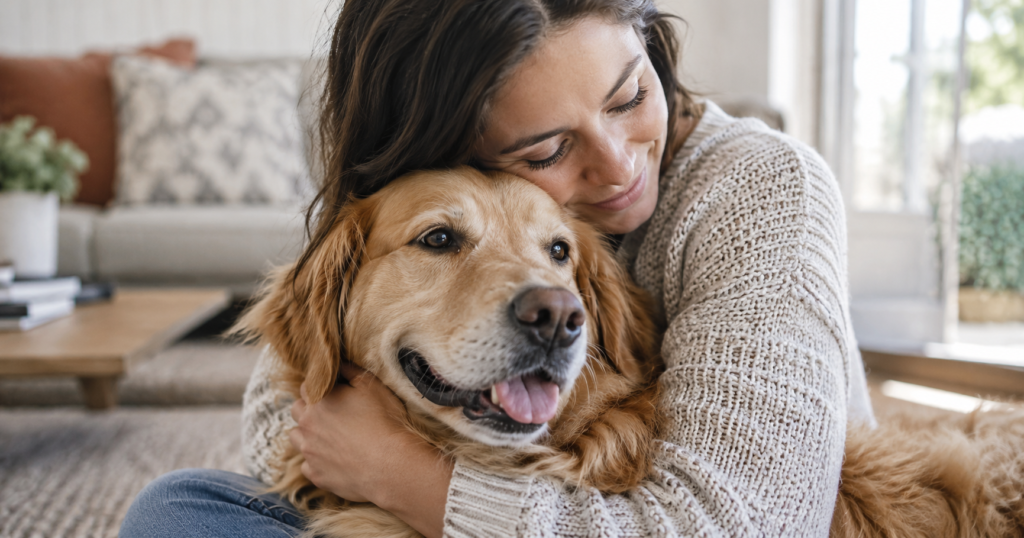
Do Dogs Like Hugs? How to Read Your Dog’s Body Language
Do dogs like hugs? The answer depends on the individual dog and what their body language shows during close physical contact.
People often use hugs to express love, comfort and affection. Dogs communicate differently. Some dogs appear relaxed when a familiar person holds them closely, while others may tolerate the interaction without actually enjoying it. For some dogs, having arms wrapped around the body can feel restrictive because it reduces their ability to move away.
The most useful question is therefore not simply whether dogs like hugs in general. It is whether your dog is relaxed, comfortable and choosing to remain in the interaction.
Learning to read dog body language can help you distinguish relaxed affection from subtle signs that your dog would prefer more space. It can also help make everyday handling, grooming and veterinary care safer and less stressful.
Some dogs appear comfortable with hugs, while others may find them restrictive or stressful. Do not judge comfort simply by whether your dog stays still. Look at the whole body. Turning away, stiffening, freezing, lip licking, ears pulled back or trying to leave may indicate discomfort. A loose body, soft expression and voluntarily staying close are more reassuring signs. When in doubt, give your dog the choice to move away.
Watch the Video
This Pawsvexa Short explains why your dog’s body language and freedom to move away matter more than assuming every human-style display of affection feels comfortable to them.
Do Dogs Like Hugs?
There is no single answer that applies to every dog.
Dogs differ in temperament, previous experience, confidence, social history, physical comfort and individual preference. A dog that has experienced gentle handling throughout life may respond very differently from a dog that is fearful, painful, unfamiliar with close restraint or uncomfortable with a particular person.
Context also matters. A dog may willingly sit pressed against an owner on the sofa but become uncomfortable when someone bends over them, puts both arms around the body and prevents them from stepping away.
This is why phrases such as “dogs hate hugs” are too absolute. Some dogs appear comfortable with close contact, but that does not mean every dog wants to be hugged, every type of hug is equally comfortable, or a dog will welcome the same contact in every situation.
The safest approach is to observe the dog in front of you rather than relying on a general rule.
Why Can a Hug Feel Different to a Dog?
Human hugging usually involves bringing the upper body close, wrapping one or both arms around another individual and maintaining physical contact for several seconds.
For a dog, that can temporarily limit movement. Being able to move closer or farther away is an important part of how dogs manage social interactions.
A dog that wants more distance may normally step away, turn aside or change position. During a tight hug, those options can be reduced.
This does not mean that every brief embrace causes fear. It means that physical restriction changes the interaction, so owners should pay closer attention to the dog’s response.
Dogs Trust advises that handling should be introduced gradually and positively and that owners should stop when a dog begins showing signs of discomfort.3
What Research Tells Us About Hugging and Dog Body Language
A 2024 paper published in Applied Animal Behaviour Science examined human-dog communication during play, petting and hugging interactions. The researchers identified a high number of stress-related behaviours in the dogs observed and highlighted how easily human intentions and canine responses can become mismatched.1
The important lesson is not that every hug automatically causes distress. The study also emphasized the importance of context, individual interactions and better understanding of canine communication.
In practical terms, owners should avoid deciding how a dog feels based only on the human intention behind the interaction. A hug may be intended as affection while the dog’s body language is communicating uncertainty or a desire for more space.
Signs a Dog May Be Uncomfortable With a Hug
Dogs often communicate discomfort long before they growl, snap or attempt to escape.
Some signals are subtle and easy to miss, particularly when a person is focused on cuddling, taking a photograph or interacting face-to-face with the dog.
Possible signs that your dog may be uncomfortable include:
- turning the head away
- leaning the body away from you
- trying to step or move away
- licking the lips when food is not involved
- yawning when the dog is not tired
- ears pulled or flattened backward
- lowering the head
- showing more of the whites of the eyes
- sudden stillness or freezing
- muscle tension or a stiff body
- a lowered or tucked tail
- avoiding eye contact
- growling or showing teeth if pressure continues
Dogs Trust and the RSPCA both describe behaviours such as turning away, lip licking, ears held back, avoidance and sudden stillness among signs that may occur when a dog is worried or uncomfortable.45
If you want a more detailed guide, read Pawsvexa’s guide to dog stress signs.
Freezing Does Not Necessarily Mean Your Dog Is Calm
One of the most easily misunderstood responses is freezing.
An owner may think, “My dog stays perfectly still when I hug him, so he must enjoy it.” But stillness alone cannot tell you whether a dog is comfortable.
A relaxed dog may certainly remain still, but a worried dog may also stop moving.
Look at everything else that is happening at the same time. Is the body loose or rigid? Are the facial muscles relaxed? Is the dog leaning toward you or away from you? Are the ears natural or pulled back? Does the dog remain close when you release them, or immediately create distance?
The overall pattern is much more informative than one behaviour in isolation.
What Does Relaxed Dog Body Language Look Like?
A dog that feels comfortable will generally look loose rather than rigid.
Depending on the individual dog and situation, reassuring signs may include:
- a loose, natural body posture
- soft facial muscles
- eyes that look normal rather than wide or fixed
- ears held in a natural position for that dog
- normal, fluid movement
- a relaxed mouth
- voluntarily remaining close
- approaching again after contact stops
- initiating contact by leaning, nudging or settling beside you
The RSPCA describes relaxed dogs as having a relaxed body posture, natural ear position and normal facial expression.5
However, even positive-looking signals should be interpreted in context. Dogs have different body shapes, ear carriage, tail types and normal resting postures.
Why One Body-Language Signal Is Not Enough
Dog body language works as a complete picture.
VCA Animal Hospitals emphasizes that canine communication involves posture, head and neck position, ears, tail, eyes, facial expression and vocalization, and that individual signals need to be interpreted in context.2
A yawn, for example, may occur because a dog is tired. Lip licking may happen after eating. Turning the head can simply mean something else caught the dog’s attention.
But several changes occurring together during a hug are more meaningful.
Imagine a dog that:
- turns its head away as the person leans closer;
- licks its lips;
- pulls the ears back;
- becomes stiff when the arms tighten;
- walks away immediately when released.
That combination provides much stronger evidence that the interaction was uncomfortable than any one signal by itself.
Use a Simple Choice Check During Petting
A useful way to learn what your dog prefers is to pause during physical contact and see what they choose to do.
- Pet your dog gently for a few seconds in an area they normally enjoy being touched.
- Stop touching them and move your hands away.
- Give them a moment to choose what happens next.
- If they approach, lean toward you or actively seek more contact, you can continue.
- If they move away, turn aside or show tension, allow the interaction to end.
This approach does not require you to interpret every tiny movement perfectly. It simply gives the dog an opportunity to participate or disengage.
Dogs Trust recommends watching for discomfort during handling and stopping if a dog becomes uncomfortable.3
Does Your Dog Coming Close Mean They Want a Hug?
Not necessarily.
A dog can want social contact without wanting to be restrained.
Your dog may enjoy lying beside you, leaning against your leg, resting their head on your lap or asking to be stroked. Those behaviours show that the dog wants proximity or interaction, but they do not automatically mean the dog wants arms wrapped tightly around the body.
This distinction is important because people often assume that a dog asking for attention is asking for every type of physical affection.
Instead, respond to the form of contact your dog appears to prefer.
Should You Stop Hugging Your Dog Completely?
There is no need for a dramatic rule if your dog clearly appears comfortable with brief, familiar contact.
The goal is not to make owners afraid of touching their dogs. It is to make physical affection more responsive to the dog.
If your dog has a loose body, chooses to remain close and continues seeking interaction when released, that is more reassuring than a dog that freezes, leans away or immediately leaves.
Keep contact gentle, avoid holding the dog so tightly that they cannot reposition themselves, and release them if their body language changes.
Some dogs may be comfortable with a brief loose embrace from a trusted person but dislike prolonged restraint, face-to-face contact or hugging by strangers.
Why a Dog May Tolerate One Person but Not Another
Dogs do not respond identically to every person.
A dog may have years of positive experience with one family member but feel uncertain around a visitor, child or unfamiliar person.
Factors that can affect the response include:
- how familiar the person is
- how quickly the person approaches
- whether the dog can move away
- the person’s body position
- previous experiences with handling
- the dog’s current stress level
- pain or illness
- the surrounding environment
A dog that enjoys sitting closely with one owner should not therefore be assumed to welcome the same contact from everyone.
Dogs, Children and Hugging
Children often show affection by putting their arms around a dog’s neck or body. They may also bring their face very close to the dog.
This can be difficult for a dog that feels trapped or overwhelmed.
Young children may also miss subtle warning signals such as head turning, lip licking, freezing or avoidance.
For safer interactions:
- supervise children and dogs closely;
- teach children not to chase, corner or restrain a dog;
- avoid encouraging face-to-face hugging;
- give the dog a quiet place where children do not follow;
- do not force the dog to remain for photographs or affection;
- end the interaction if the dog tries to create distance.
This is especially important with unfamiliar dogs, dogs that are sleeping, dogs that are eating, dogs in pain or dogs already showing signs of stress.
Better Ways to Show Your Dog Affection
Affection does not need to look human to be meaningful.
Many dogs enjoy interactions that preserve freedom of movement and allow them to participate voluntarily.
1. Gentle Petting
Pet your dog in areas they already appear to enjoy. Preferences vary, so observe the response rather than assuming every dog likes the same type of touch.
2. Play
A short game with a favorite toy can be highly rewarding for dogs that enjoy play.
3. Walking and Sniffing
Shared walks provide exercise, exploration and opportunities to use the sense of smell.
4. Positive Training
Short reward-based training sessions can create enjoyable, predictable interaction between a dog and owner.
5. Quiet Companionship
Some dogs simply enjoy resting near their person without being held.
6. Letting the Dog Initiate Contact
When your dog approaches and asks for attention, respond in a way they consistently appear to enjoy.
The best expression of affection is not necessarily the one that feels most meaningful to a human. It is the one the dog experiences positively.
Can You Teach a Dog to Feel More Comfortable With Handling?
Yes, many dogs can become more comfortable with necessary handling when it is introduced gradually and associated with positive experiences.
This is especially useful for grooming, checking ears and paws, putting on equipment and veterinary examinations.
Dogs Trust recommends starting with gentle contact in an area the dog already tolerates well, keeping sessions short and gradually increasing handling while monitoring body language.3
The goal should not be to repeatedly overwhelm a dog until they “give up.” Progress should occur at a level where the dog can remain comfortable.
For more preparation around examinations and handling, see Pawsvexa’s guide on how to make vet visits less stressful for your dog.
What If Your Dog Suddenly Stops Wanting to Be Touched?
A sudden change in tolerance of touch deserves attention.
A dog that previously enjoyed being handled but suddenly moves away, growls, stiffens or reacts when touched may be experiencing pain or another medical problem.
Possible examples include discomfort involving the:
- neck or back
- hips or joints
- ears
- mouth or teeth
- skin
- abdomen
- paws or nails
Pain does not always cause obvious limping or crying. Sometimes a behavioral change is one of the first things an owner notices.
Dogs Trust notes that pain and medical issues can affect how dogs respond to touch and handling.4
If the change is new, unexplained or worsening, arrange a veterinary assessment rather than assuming the dog has suddenly become “stubborn” or unfriendly.
What Should You Do if Your Dog Growls During a Hug?
Stop the interaction and give your dog space.
Growling is communication. It tells you that the dog is uncomfortable enough to produce a more obvious warning.
Do not continue holding the dog to prove that “nothing bad will happen.” Continuing restraint when the dog is trying to communicate discomfort may increase the pressure on the situation.
If growling, snapping or defensive behaviour is new, a veterinary examination is important because pain may contribute.
If medical problems are ruled out but the behaviour continues, ask your veterinarian about referral to an appropriately qualified clinical animal behaviour professional.
When Should You Get Professional Help?
Professional advice is appropriate when handling regularly causes significant fear or defensive behaviour.
Contact your veterinarian if your dog:
- suddenly becomes sensitive to touch;
- yelps or appears painful when handled;
- repeatedly freezes during normal contact;
- actively avoids being touched;
- growls or snaps during handling;
- shows a major change from previous behaviour;
- seems uncomfortable during grooming or veterinary examination;
- becomes increasingly fearful despite gentle handling.
The veterinarian can first assess for medical causes and then recommend appropriate behavioral support when needed.
FAQ
Do dogs like being hugged by their owners?
Some dogs appear comfortable with brief close contact from familiar people, while others may tolerate hugs without enjoying them. Watch the dog’s whole body and give them the ability to move away.
Why does my dog stay still when I hug them?
Stillness can occur during relaxation, but it can also occur when a dog is worried or unsure. Look for other signals such as muscle tension, ears pulled back, head turning, lip licking, wide eyes or what the dog does immediately after the hug ends.
Why does my dog turn their head away when I hug them?
Turning away can be a way of reducing social pressure or creating distance. It should be interpreted together with the rest of the dog’s body language and the surrounding situation.
Why does my dog lick their lips when I hug them?
Lip licking can have several causes, including food-related behavior, but it may also occur during stress or uncertainty. If it repeatedly appears together with turning away, tension or attempts to leave during hugs, the interaction may be uncomfortable.
Is it safe to hug an unfamiliar dog?
It is safer not to restrain an unfamiliar dog with a hug. Allow the dog space and follow the owner’s guidance. A dog that does not know you may be less comfortable with close physical contact.
Should children hug dogs?
Children should be taught to interact with dogs without restraining or cornering them. Close adult supervision is important, and face-to-face hugging should be avoided, especially with unfamiliar or uncomfortable dogs.
Does leaning against me mean my dog wants a hug?
Not necessarily. Leaning can be a form of social contact, but a dog may enjoy leaning while still disliking having both arms wrapped around the body. Respond to the specific type of contact the dog appears to choose.
Can a dog learn to tolerate hugs?
Dogs can often become more comfortable with handling through gradual, positive training. However, there is usually no need to teach a dog to accept prolonged hugging simply for human affection. Handling training is most useful for practical needs such as grooming and veterinary care.
Can pain make my dog dislike hugs?
Yes. Pain or illness can reduce tolerance for touch and restraint. A sudden change in response to normal handling should be discussed with your veterinarian.
What is the best way to show affection to my dog?
Use interactions your dog clearly enjoys. Depending on the individual, that may include gentle petting, play, training, walking, resting together or allowing the dog to initiate contact.
The Pawsvexa Takeaway
So, do dogs like hugs? Some appear comfortable with them, while others would rather have more freedom and space.
The important part is not the human intention behind the hug. It is the dog’s response.
Watch for a loose body, natural movement, soft expression and voluntary closeness. Pay attention to turning away, stiffness, freezing, avoidance, lip licking, ears pulled back or attempts to leave.
Most importantly, give your dog a choice.
When affection allows the dog to participate rather than simply endure the interaction, it is easier to build trust and reduce unnecessary stress.
Get the free Pawsvexa Pet Emergency Checklist with 12 warning signs every dog and cat owner should know.
Get the Free Pet Emergency Checklist
Free to download. Created by a qualified veterinarian.
Final Thoughts
Hugging is an intuitive expression of affection for people, but responsible pet care means considering how an interaction feels from the dog’s perspective too.
You do not need to become nervous about touching your dog or analyze every movement obsessively. Instead, learn your dog’s normal body language, notice changes and make space for choice.
A dog that seeks you out, relaxes beside you and returns for more contact is giving useful information about what they enjoy.
A dog that repeatedly turns away, stiffens or tries to leave is also giving useful information.
Respecting both types of communication can make physical affection calmer, safer and more meaningful.
Veterinary Note
A sudden change in tolerance of touch, restraint or handling can sometimes be associated with pain or illness. If your dog becomes unexpectedly sensitive, defensive, reluctant to move or uncomfortable when touched, arrange a veterinary examination before assuming the problem is purely behavioral.
Dogs showing repeated fear, growling, snapping or other defensive behavior around handling may also benefit from an individualized plan developed with a veterinarian and, when appropriate, a qualified clinical animal behaviour professional.
This article is intended for general educational purposes and does not replace a veterinary examination, diagnosis, individualized behavior assessment or treatment plan.
Sources and Further Reading
-
Walsh EA, Meers LL, Samuels WE, et al.
Human-dog communication: How body language and non-verbal cues are key to clarity in dog directed play, petting and hugging behaviour by humans.
Applied Animal Behaviour Science. 2024;272:106206.
View source -
VCA Animal Hospitals.
Canine Communication – Interpreting Dog Language.
View source -
Dogs Trust.
How to Handle Your Dog.
View source -
Dogs Trust.
Helping Dogs Cope With Fear and Big Emotions.
View source -
RSPCA.
Understanding a Dog’s Body Language.
View source -
American Kennel Club.
Do Dogs Like Hugs? What Your Dog Is Really Feeling.
View source
Written by a veterinarian for Pawsvexa.