
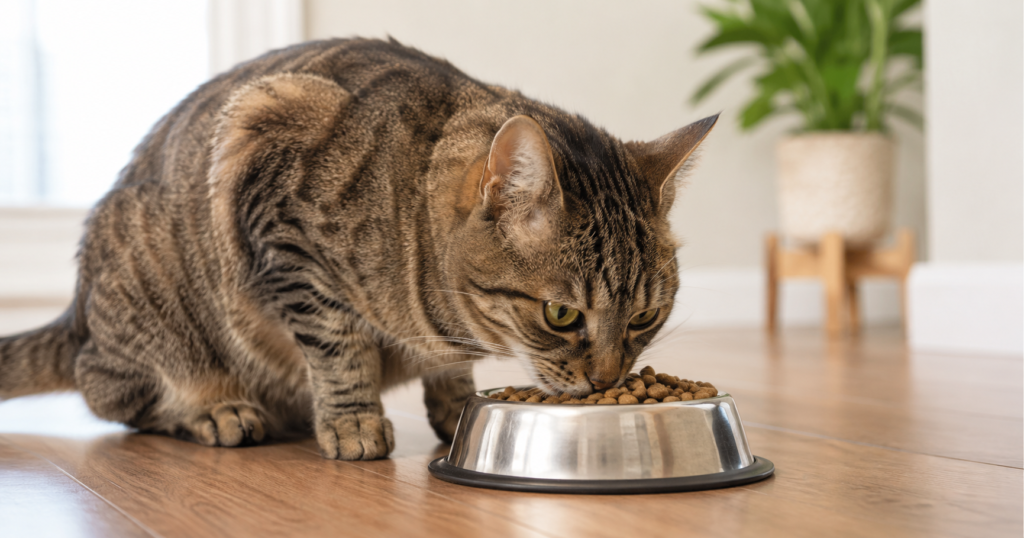
If you have ever wondered, “why is my cat always hungry?”, the answer is not always straightforward. Some cats are enthusiastic about food because of routine, learned behavior, age, activity level, or the way their meals are managed.
However, a noticeable increase in appetite can sometimes be an important health clue. This is especially true when your cat is eating more while losing weight, drinking more water, urinating more often, vomiting, having diarrhea, or showing other new changes.
The important question is not simply whether your cat likes food. It is whether their appetite has changed, whether their body weight is changing, and whether other symptoms are appearing at the same time.
Quick Answer: A cat that frequently asks for food is not automatically sick. Learned begging, feeding routines, growth, calorie needs, and competition with other pets can all contribute. But a new or marked increase in appetite deserves closer attention, particularly when it occurs with weight loss, increased thirst or urination, vomiting, diarrhea, or a decline in overall condition.
Watch the Video
Why Is My Cat Always Hungry? When to Call Your Vet
This Pawsvexa Short explains when increased appetite may be normal food-seeking behavior and when it deserves veterinary attention.
Why Is My Cat Always Hungry?
Cats differ considerably in how interested they are in food. Some quietly eat what they need, while others seem ready for another meal almost immediately.
The first step is to distinguish between a cat that behaves as though it is hungry and a cat experiencing a genuine increase in appetite, sometimes called polyphagia.
A cat that has always begged before meals but maintains a stable, healthy body condition may simply have learned that certain behaviors lead to food. A cat that suddenly begins eating much more than usual is different, particularly if its weight or general health is also changing.
Common Non-Medical Reasons a Cat May Seem Hungry All the Time
1. Your Cat Has Learned That Begging Works
Cats are very good at learning routines. If meowing, following you into the kitchen, waking you early, or sitting beside the food cupboard repeatedly results in a snack, the behavior can become strongly reinforced.
In this situation, the cat may not have an abnormal physical appetite. Instead, it has learned that food-seeking behavior is effective.
This is why automatically giving additional food every time a cat asks can make the pattern stronger.
2. The Daily Food Amount May Not Match the Individual Cat
Feeding recommendations on pet-food packaging are useful starting points, but they cannot account perfectly for every cat. Age, body size, activity, reproductive status, health, and individual metabolism all influence energy needs.
The goal is not simply to follow a number on a packet. The more useful approach is to monitor your cat’s body weight and body condition and adjust feeding appropriately with veterinary guidance when needed.56
3. Growing Kittens Often Need More Energy
A growing kitten has very different nutritional needs from a sedentary adult cat. Kittens require sufficient calories, protein, fat, vitamins, and minerals to support growth and development.7
A healthy kitten may therefore appear considerably more food-motivated than an adult cat.
However, a kitten that eats well but fails to grow appropriately, loses weight, develops diarrhea, has a pot-bellied appearance, or seems unwell should be evaluated rather than assumed to be simply hungry.
4. Meal Timing Can Influence Food-Seeking
Some cats become particularly demanding around predictable feeding times. Others may struggle when their entire daily allowance is offered in a pattern that leaves long periods without food.
There is no single feeding frequency that is ideal for every cat. Meal structure can be individualized according to the cat’s health, household routine, and total daily food allowance.
The important point is that changing meal frequency should not accidentally increase the total daily calories.
5. Multi-Cat Households Can Make Feeding Difficult to Judge
When several cats share feeding areas, it can be surprisingly difficult to know how much each individual cat is actually eating.
One cat may steal food while another eats too little. A cat that appears constantly hungry might therefore be receiving less food than expected—or it may simply have learned to search for additional opportunities to eat.
Feeding cats separately when necessary can make intake easier to monitor.
When Increased Appetite Can Be a Medical Sign
A genuine increase in appetite becomes more concerning when it is new, persistent, or associated with other physical changes.
Several medical conditions can cause a cat to eat more while still losing weight or failing to maintain normal condition.
Hyperthyroidism
Hyperthyroidism is an important cause of increased appetite in middle-aged and older cats. It occurs when the thyroid gland produces excessive thyroid hormone.
Typical signs can include weight loss despite a good or increased appetite, increased thirst, increased urination, hyperactivity, vomiting, diarrhea, and changes in coat quality.1
Not every affected cat shows every sign, which is why a change in appetite and body weight should be considered in the context of the whole cat.
Diagnosis commonly involves a veterinary examination and blood testing, including evaluation of thyroid hormone levels such as total T4.1
Diabetes Mellitus
Diabetes can also cause a cat to eat well or appear unusually hungry while losing weight.
When the body cannot use glucose effectively, tissues are unable to access energy normally. The body may then break down fat and protein despite continued food intake.
Common owner-observed signs include weight loss, increased thirst, and increased urination, sometimes accompanied by increased appetite.28
A cat that suddenly begins emptying the water bowl more quickly, producing noticeably larger urine clumps, and eating more while becoming thinner needs veterinary assessment.
Gastrointestinal Disease and Poor Nutrient Absorption
Some gastrointestinal disorders interfere with digestion or the absorption of nutrients.
In these cases, a cat may eat a reasonable or even large amount of food but still lose weight because nutrients are not being used normally.
Chronic intestinal disease and malabsorption syndromes can be associated with weight loss, diarrhea, vomiting, and changes in appetite, including increased appetite in some animals.3
Importantly, significant intestinal disease does not always produce obvious diarrhea, so normal-looking stools do not completely exclude a gastrointestinal problem.
Intestinal Parasites
Gastrointestinal parasites are another possible contributor, especially in kittens or cats with relevant exposure risks.
Parasites can cause signs including poor growth, weight loss, diarrhea, vomiting, anemia, poor coat condition, or abdominal changes depending on the parasite involved.4
Some infected cats show few obvious signs, so fecal testing may be recommended when parasites are a realistic possibility.
Parasites should not automatically be blamed for every hungry adult cat. They are one part of the veterinary differential diagnosis rather than a universal explanation.
Other Medical or Medication-Related Causes
Appetite can also be influenced by other illnesses and by certain medications. This is one reason a veterinary history matters.
If your cat’s appetite changed after starting medication, after another illness, or alongside changes in behavior, weight, digestion, thirst, or urination, mention the timing to your veterinarian.
Why Hunger Plus Weight Loss Matters
One of the most useful distinctions for an owner is whether a hungry cat is maintaining, gaining, or losing weight.
A cat that eats more but becomes thinner deserves attention because increased food intake is not translating into stable body condition.
Hyperthyroidism, diabetes mellitus, and some gastrointestinal diseases are important examples of conditions in which increased appetite and weight loss may occur together.123
Weight changes can be gradual, and they are sometimes difficult to notice when you see your cat every day. Regular weighing can therefore be more useful than relying on appearance alone.
What If Your Cat Is Eating More and Drinking More?
Increased appetite becomes more significant when it occurs alongside increased thirst or increased urination.
Both hyperthyroidism and diabetes can produce combinations of these signs.12
If you notice that your cat is visiting the water bowl much more frequently, drinking from unusual places, or producing larger or more numerous urine clumps, do not consider the appetite change in isolation.
For more information about normal interest in moving water versus a genuine change in thirst, see Why Do Cats Prefer Running Water?
Warning Signs That Should Not Be Ignored
Contact your veterinarian if increased hunger is new or persistent, especially when accompanied by one or more of the following:
- Weight loss despite eating normally or more than usual
- A noticeable increase in thirst
- More frequent or larger-volume urination
- Repeated vomiting
- Persistent or recurrent diarrhea
- Poor coat condition
- Marked restlessness or unusual hyperactivity
- Weakness or reduced activity
- Failure of a kitten to grow normally
- A major change from your cat’s usual eating pattern
The presence of several changes together is generally more informative than appetite alone.
What to Track at Home Before the Veterinary Visit
You can help your veterinarian by providing specific observations instead of simply saying that your cat seems hungry.
- Measure the food. Record how much food is actually offered each day.
- Track body weight. Note whether your cat is stable, gaining, or losing weight.
- Watch water intake. Look for a noticeable change from the cat’s normal pattern.
- Monitor the litter tray. Larger or more frequent urine clumps may be important.
- Record vomiting or diarrhea. Include frequency and duration.
- Note medication changes. Record when any new treatment started.
- Observe behavior. Changes in activity, restlessness, weakness, or grooming can provide additional clues.
A short video of unusual feeding behavior can also be useful when the behavior is difficult to describe during an appointment.
What Might Your Veterinarian Check?
The exact investigation depends on your cat’s age, examination findings, history, and other symptoms.
A veterinarian may begin with a physical examination and assessment of body weight, body condition, hydration, heart rate, thyroid area, abdomen, coat, and general condition.
Depending on the case, screening may include blood tests, urinalysis, fecal testing, and thyroid testing in appropriate cats.18
For suspected diabetes, assessment of blood glucose and urine glucose is important, with additional tests sometimes used because stress can temporarily increase blood glucose in cats.8
The aim is not to perform every test on every hungry cat. The aim is to identify whether the appetite change fits a behavioral pattern, a nutritional issue, or a medical problem that needs investigation.
If Your Cat Is Healthy but Constantly Begs for Food
If your veterinarian has ruled out relevant medical problems and your cat is at an appropriate body condition, the focus can shift toward feeding management.
Helpful strategies may include:
- Measure the full daily food allowance rather than estimating portions.
- Avoid repeatedly adding unplanned snacks.
- Divide the same daily amount into several smaller meals when appropriate.
- Use timed feeders where they fit the household routine.
- Consider puzzle feeding or other controlled food-based enrichment.
- Feed cats separately if one animal steals another’s food.
- Track body weight and body condition instead of judging hunger by begging alone.
The total daily intake still matters. Splitting one appropriate daily amount into more feeding opportunities is different from increasing calories every time the cat asks for food.
What If My Cat Is Overweight but Always Hungry?
An overweight cat can still beg persistently for food. Begging does not prove that the cat needs more calories.
Body condition should be assessed independently from food-seeking behavior. WSAVA nutrition guidance emphasizes assessment of body condition and muscle condition as part of individual nutritional evaluation.6
Do not place an overweight cat on an aggressive or improvised crash diet. Cats need nutritionally appropriate weight-management plans, and overly severe food restriction can create health risks.
Your veterinarian can help determine an appropriate target weight, diet, feeding amount, and monitoring schedule.
What Not to Do
- Do not assume every hungry cat simply needs more food.
- Do not ignore weight loss because the cat is still eating well.
- Do not repeatedly increase portions without monitoring body condition.
- Do not assume parasites are the explanation without appropriate veterinary assessment.
- Do not make major dietary changes solely because of online advice when your cat is losing weight or showing other symptoms.
- Do not delay a veterinary appointment when several warning signs occur together.
Frequently Asked Questions
Is it normal for a cat to act hungry all the time?
Some healthy cats are highly food-motivated or have learned to beg successfully. What matters is whether the behavior is longstanding and whether body weight, thirst, urination, digestion, and general health remain normal.
Why is my cat always hungry but still skinny?
Eating more while losing weight deserves veterinary attention. Hyperthyroidism, diabetes, gastrointestinal disease, and other medical problems can produce this pattern.123
Why is my older cat suddenly hungry all the time?
A sudden appetite increase in an older cat should not automatically be dismissed as normal aging. Hyperthyroidism is particularly important to consider in middle-aged and older cats and commonly causes weight loss with increased appetite.1
Can diabetes make a cat hungry?
Yes. Diabetes can cause increased appetite while the cat loses weight, often alongside increased thirst and urination.28
Can worms make a cat hungry?
Gastrointestinal parasites can contribute to poor growth, weight loss, digestive problems, or changes in condition, particularly in kittens and cats with relevant exposure. They are possible causes but should not be assumed without appropriate assessment and testing.4
Should I give my cat more food every time it begs?
Not automatically. First consider the cat’s total daily intake, weight, body condition, age, activity level, and health. Healthy cats should receive an appropriate measured daily amount rather than unlimited extra portions simply because they ask.
When should I call my veterinarian about increased appetite?
Arrange a veterinary check if the appetite increase is sudden, persistent, or accompanied by weight loss, increased thirst, increased urination, vomiting, diarrhea, poor condition, weakness, or another significant change.
The Pawsvexa Takeaway
A cat that loves food is not necessarily a sick cat. Food-seeking can be shaped by routine, learned behavior, feeding patterns, growth, and individual calorie needs.
What deserves attention is a change from normal.
If your cat suddenly becomes much hungrier—particularly while losing weight, drinking more, urinating more, or developing gastrointestinal or behavioral changes—do not solve the problem simply by filling the bowl again. Look at the whole pattern and speak with your veterinarian.
Be prepared before a pet emergency happens.
Keep Pawsvexa’s practical pet-care resources easy to reach so you know what to check and when veterinary help may be needed.
Final Thoughts
Appetite is useful information, but it should never be interpreted alone.
A consistently food-motivated cat with stable weight and no other changes may simply need better meal structure or feeding management. A cat whose appetite has suddenly increased while its body condition or other habits are changing deserves a different response.
Track what is actually happening: food intake, body weight, water consumption, urination, stools, vomiting, behavior, and general condition. Those details can make it much easier to determine whether your cat is simply enthusiastic about dinner or showing an early sign of illness.
Veterinary Note
Increased appetite is a clinical sign, not a diagnosis. Its significance depends on the cat’s age, body condition, weight trend, medical history, medications, feeding routine, and accompanying symptoms. A veterinary examination is appropriate when the change is new, substantial, persistent, or associated with weight loss or other abnormalities.
This article is intended for general educational purposes and does not replace an individual veterinary examination, diagnosis, or treatment plan. If you are concerned about a change in your cat’s appetite or health, contact your veterinarian.
Sources and Further Reading
-
Cornell Feline Health Center.
Hyperthyroidism in Cats
. -
Cornell Feline Health Center.
Feline Diabetes
. -
MSD Veterinary Manual.
Malabsorption Syndromes in Small Animals
. -
MSD Veterinary Manual.
Gastrointestinal Parasites of Cats
. -
Cornell Feline Health Center.
Feeding Your Cat
. -
World Small Animal Veterinary Association.
Global Nutrition Guidelines
. -
MSD Veterinary Manual.
Kitten Care
. -
VCA Animal Hospitals.
Testing for Increased Appetite
.
Written by a veterinarian for Pawsvexa.